Thursday, March 26, 2009

Off the shelf: Alien: The Illustrated Story (1979)

This is one of those books that I've really really wanted to read ever since I first heard about it a very long time ago. I mean, how could you not want to read this? It's got Archie Goodwin, one of the all-time great writers and the guy who wrote the best Star Wars comics ever. And then its got art by Walter Simsonson. Yes, the same Walter Simonson who did Manhunter with Goodwin, made Marvel's Battlestar Galactica into a surprisingly good comic and then did a definitive and long run on Thor.

But for whatever reason, I never picked this up until now. Part of that is that I don't think I've ever seen a copy in any of the dozens of comics shops I"ve frequented over the years. The other part being it just never came to mind as something to get on eBay, until now.

And despite the long wait and the high expectations, this really did live up to my expectations. First, Alien is a great movie, one of the best from that heady period between Star Wars and the mid-1980s, when almost every sci-fi/superhero movie coming out had at least something to recommend it. (Consider Superman: The Movie, the first couple of Star Trek movies, Raiders of the Lost Ark, Blade Runner, E.T., Close Encounters of the Third Kind, Tron ... and that's without getting into secondary stuff like The Last Starfighter or Krull.)

What I love the most is this book works as both an adaptation that accurately conveys the story and the experience of the movie and as a damn fine comic book with smart scripting and excellent art.

I have no idea what the reaction to this book might have been. The indicia says it came out in 1979, same year as the movie, but its in a format where the dimensions are similar to a magazine yet the quality of the paper and the ad-free interior are like a book. It's a bit like what Marvel and DC would try a few years down the road with their original graphic novel format. The pages are larger than the average comic, which lets Goodwin and Simonson put more panels on a page without having to make them too small. The coloring is excellent and the lettering is by John Workman, so you know it's good. I imagine this must have sold on newsstands alongside things like Heavy Metal magazine (HM published this adapation by the way — and it looks like it could have been serialized in the magazine. I don't know.) All this for the original cover price of $3.95 — not much less than what I just paid for it recently on eBay.

The only downside is there's now one less lost gem to cross of my list ... I'll have to start looking for another.

Wednesday, March 25, 2009

Off the Shelf: Scott Pilgrim vs. the Universe, Vol. 5

I overall really like the Scott Pilgrim series by Bryan Lee O’Malley, who gets points from me for being a fellow expat Canadian. I am, however, a little puzzled by the extent of the fervor that surrounds the release of each new volume in this series — something I think I have to put down to a slight generational gap. If I was 17, or maybe even 24, I’m sure I would think this is much more clever, funny and, like, so true than I do at age 39.

But it is a fun book. This volume, to my surprise, comes with some kind of flashy foil cardstock cover of the like I haven’s seen since Valiant last went under. To be honest, I would rather have had some color interior pages, as was done in at least one of the previous volumes. What I like about it is it doesn’t take itself too seriously. Scott Pilgrim remains a pretty clueless slacker, but he’s a funny clueless slacker and the story — much like the real world — doesn’t really punish guys like that for their rather minor flaws. But despite not being heavy or preachy, there’s enough recognizable real life and real emotion in this book to make it charming.

I also like O’Malley’s artwork, which is in many way is a perfect match for the material, evoking equal parts manga and Life in Hell. It’s also low-fi enough to retain the feeling of reading some sort of underground, zine-like comic that only the other cool kids know about — which also fits in perfectly. I imagine some day, there will be some kind of absolute edition featuring a large page size and color, though I can’t imagine either would improve things that much.

Again, even though I really like this series, it’s not for me the second coming of Stan Lee the way it seems to be for some fans. And in some ways, I’m a bit jealous of that because it’s been quite a while since I’ve found a comic that really evokes that sense of discovery in me — again, part and parcel, I think of me no longer being 24 years old.

Tuesday, March 24, 2009

Comic du jour: The Bionic Woman #1 (Oct. 1977)

It’s been a long time since I’ve seen an episode of the TV show this comic is based on, but I hope it was better and less silly than this comic from Charlton.

To say something nice about this book, the art is interesting and offers a decent likeness of actress Lindsay Wagner. But the story! Let’s get to it ….

First off, is a little ditty called “Rico, Come Home.” In it, Jaime Sommers gets involved in the personal life of the child Rico when the kid is nearly abducted in an extensive family dispute involving Rico’s dead father, rich grandfather and normal mother. It’s kind of confusing, but it somehow ends with Rico nearly falling off a cliff into the ocean and Jaime saving him. I guess in the 1970s it might have made sense if you just looked at the pictures, but still …

The second story is titled “Weaker Sex?” and is pretty much what you’d expect. Oscar Goldman, in all his wise manliness, decides Jaime doesn’t need to have her bionics on all the time — he’s only going to give her super strength and speed when she goes on dangerous missions. He then proceeds to send her on a mission in which she’s disguised as a flight attendant so she can keep an eye on a recently paroled terrorist who’s being returned to Algiers on a commercial flight. This, apparently, doesn’t qualify as dangerous, but she does get to wear a cute flight attendant hat that, were it made of paper, would require to ask folks to drive through, please. Of course, shit goes wrong and she has to save the day without her powers, prompting Oscar to realize he was being an ass and restore her powers.

There aren’t any credits that I can see, but I will say the art is not bad — especially for a Charlton book of this era. It also manages to be only slightly more entertaining than the NBC revival series that came out last year and could have easily exceeded it had only Max the bionic dog made an appearance.

Monday, March 23, 2009

Comic du jour: Giant-Size Man-Thing #1 (Aug. 1974)

I bought this comic recently at flea market pretty much only because of the title. In general, swamp monsters and 1970s horror comics have never held much interest for me, but this was a lot more fun than I expected.

I imagine a lot of that comes down to writer Steve Gerber, who gives the story a kind of hip, tongue-in-cheek quality that keeps things lively. How else can you describe a story in which some occultists worship The Golden Brain, which falls into the swamp and emerges as a blank slate in a perfect body and joins a sort of hippy commune based on alternative energy sources. The cultists, who lost the brain during a scuffle with the Man-Thing, are ruled by a guy name Yagzan, who looks a lot like Richard Nixon. (And yes, there’s a bit of serendipity with a Nixon lookalike in an issue cover-dated with the month he resigned as president.)

There’s also a hip city radio reporter named Richard Rory, who looks a lot like Marvel’s then editor-in-chief Roy Thomas. Of course, Yagzan conjures a muck monster to fight with Man-Thing and the Man-Thing wins out, with Yagzan during to stone or something and sinking into the swamp. All of this is pretty fun, with fun art from Mike Ploog and Frank Chiaramonte and that color palette that only existed in the 1970s from Petra Goldberg.

All in all, a cool story, but there also was a great trilogy of backup tales reprinting monster tales from pre-hero Marvels drawn by Steve Ditko and Jack Kirby. I get why some folks really love these little oddball gems — they’re simple and fun diversions — even though I’m not likely to spend the big bucks on Marvel Masterworks or Omnibus editions because while the art is good, the stories just remind of other versions that I think work better (even though these comics came first).

For example, the ending of Ditko’s “Ice-Monster Cometh” reminds me of the gorilla gag at the end of Trading Places, while the plot device in "Goom! The Thing from Planet X," in which the rampaging alien turns out to be a child, falls short of many similar tales told later on in the various incarnations of Star Trek. (I’m thinking in particular of “The Squire of Gothos.”) And I can’t help but evoke in my mind the bass player for U2 when the scientist in “I Was the Invisible Man!” introduces himself as Adam Clayton.

All in all, a cool comic with a funny name.

Saturday, March 21, 2009

Comics du jour: X-Men #100-109, Uncanny X-Men #381-389 (2000)

This run of 22 comics — X-Men #100-109, The Uncanny X-Men #381-389, X-Men Annual 2000, Cable #87 and Bishop: The Last X-Man #16 — constitutes the much-heralded return of Chris Claremont to writing the X-Men after almost 10 years away. Fan response to this run, which hit in 2000 as the first X-Men movie was released in theaters, was pretty negative — I don't think Claremont ever took as many public knocks on his stories as he did the the letter cols toward the end of this run. And I can see why this run didn't exactly knock anyone's socks off. While not a total train wreck, this run in many ways undid a lot of the romantic notions fans who decried Claremont's sudden departure from the X-Men in 1991 still clung to.

Perhaps the biggest and most obvious realisation to come from this run is the importance of a good artist when working (I presume) Marvel style. The issues drawn by the better artists, like Leinil Francis Yu, Adam Kubert and Salvador Larocca are the best. The problem is there were many issues drawn — at times in rushed fashion — by the likes of Tom Raney, German Garcia, Michael Ryan, Randy Green, Scot Eaton, Thomas Derenick, Anthony Williams, Brett Booth. The transitions could be jarring, with more than one issue using multiple pencilers. That sort of inconsistency was most apparent in the many convoluted battle scenes, many of which became incomprehensible and even pointless. The coloring also did this run no favors with dark skin tones and colors that ran together and muddled the art rather than made it pop.


But the real reason to pay attention to these books when they came out was Claremont, who ended his unbroken 16-year run as writer on X-Men rather suddenly in 1991. To many fans, Claremont was X-Men — no one else, no matter how hard they tried, made this book their own in quite the same way. There were lots of elements Claremont brought back to this book that were quite welcome and almost nostalgic in the way they evoked the feel of the book from the old days. Among them:

The idea that the X-Men were smart in addition to just strong. For example, the way Rogue took on a leadership role that included her learning how to fly, some engineering and some people skills. Kitty's engineering and tech expertise is another.


The attitude: There was lots of talk about X-Men needing to live up both individually and as a group to increasingly high standards. The X-Men's enemies were never dumb and never stood still — as they worked and improved their skills toward achieving their own goals, so must the X-Men always do the same and be ready for anything and everything. Loyalty and competition are big themes in Claremont's X-Men — his characters stick together, fight hard and play hard.

Having fun — Claremont always had his team blow off steam and have some fun. Yeah, there's the usual baseball games, but also more than a few nights out partying, dancing and (I presume) drinking a bit as well.

Romance — Yes, these relationships were tortured, especially Gambit and Rogue, but they also had a palpable commitment that came through and was more than the usual surface-deep stuff normally found in superhero comics. Sometimes, it was just adding a bit of glamour, as in the descriptions of Kitty's short-lived romance and betrayal by Seth in X-Men #100. But it's there. And the heartbreak is pretty convincing too, as with Psylocke moving away from (and breaking up with) Archangel and seemingly into the arms of the new Thunderbird, Neal Sharra.


The supporting characters — I always liked that there were folks around who didn't have powers in the X-books. Col. Vazhin and Simyon Kurasov in the Russia story are good examples, as is the long-absent captain of the Arcadia, Lee Forrester, and her first mate, Paolo. It makes sense for them to have non-mutant interactions with people who are nonetheless smart and interesting.

The crazy shit — Yeah, a lot of the plot ideas don't get wrapped up nice and neat. But the idea that all kinds of strange stuff would happen to you as a superhero group like the X-Men in some ways works better and makes more sense.

So then, there's the stuff that doesn't work.

First and foremost is the scripting style. I don't mind there being a lot of type to read in a comic — the packing in of ideas and bits of character through dialogue can really add to the believability of a superhero world — but the internal dialogues that rage through the minds of characters like Cecilia Reyes as they're being hunted didn't offer much new in these cases. Also, these issues in particular seemed to suffer in particular quite accutely from another common Claremont criticism, that being that his characters' dialog is pretty interchangeable. Too often, it's a phonetically spelled-out accent or, in the case of Wolverine, his own lettering font.


Sudden, unexplained changes in powers — I always liked the faux scientific authenticity the mutant explanation for powers gave the X-Men. It's a close-enough variation on real scientific principles to really sell to an audience. But messing too much with powers can undermine that believability. Cable has always been a prime offender — whether he is a telepath, a telekinetic or both changes from year to year — and this run takes a lot of joy in messing with Rogue and Psylocke. The former's powers are running out of control and becoming so random seemingly for the reason of giving her an extra burden to handle. The same thing happens to Cecelia Reyes, though a more reasonable explanation is given for it: She is forced to the the power-amplifying but addictive drug Rave to stay alive when she's trapped inside the Neo's fortress. Psylocke, on the other hand, simply shows up as a telekinetic with out telepathy. (Claremont planned to tell the story of how this happened in an annual, but left the title before he could do it.) There also are a lot of costume changes, which I don't mind as much — though I wish the changes that were made to the costumes were better.


The villains were another problem. The Neo had the most potential. Mutants of mutants, they were on the verge of extinction and out for revenge. Domina and Jaeger remain fairly memorable. But when their plot was unresolved in this run, it seems to have largely vanished from X-Men lore. The rest came fast and furious without, in some cases, so much as a good look at these characters or any understanding of their motives: The Shockwave Riders, The Lost Souls, Big Casino, Tullamore Voge, The Crimson Pirates, The Twisted Sisters, etc. Even the few returning foes seen in this run — Lady Deathstrike, Mystique — fail to stand out the way they should.

But the biggest problem with this run of books is the pacing is a complete mess. Individual scenes are well done, but the majority of it is quite confusing, even when you're really paying attention. The stories are so overpacked with ideas — many of them potentially very good — and they squeeze each other out. Nothing has priority, so there's no arc through individual issues or the run as a whole to define it. Had there been more control over the stories, sequences that should have been very powerful, like the deaths of Senator Kelly and Moira MacTaggart, would have felt more dramatic, cathartic and natural rather than seemingly jammed in around a whole bunch of other elements.


So while the early issues delivered on some of the better elements, the middle of this run was where things really faltered — and really, it only was for a few months' worth of comics — and then ran afoul of the Maximum Security crossover from the Avengers. The Dream's End crossover with Cable and Bishop: The Last X-Man showed signs of improvement, but remained unsatisfying both for the reasons cited above and its repetition of "Days of Future Past." The best issue, by far, was the penultimate one, The Uncanny X-Men #389, in which Claremont and Larocca — easily the best artistic match on the run — rather poignantly recounted unseen elements of the Xavier-Moira relationship while intercutting with both her funeral and Kelly's. There also was a decent subplot that planted the seeds for the original concept of Claremont and Larocca's X-Treme X-Men series.

All this added up to a bit of a mess and some difficulty for Marvel. Rumors have always run rampant that this run's impenetrability and its divergence from what moviegoers saw on screen that summer played a role in the changing of the editorial regime that brought in Joe Quesada, Bill Jemas and, notably for the X-Men, Grant Morrison. I still can find things to admire about this run, though it still disappoints, failing by a long shot to live up the best work Claremont did on the book in the 1980s. Those things I admire, though, also give me hope that Claremont and Tom Grummet can find a way to make X-Men Forever, the upcoming continuation of Claremont's original run, will deliver in a way this run did not.


Tuesday, March 17, 2009

Happy St. Patrick's Day with Proinsias Cassidy

I wonder how many comics fans in America drank their first pint of Guinness (or any kind of stout for that matter) because of Garth Ennis's stories in Hellblazer and Preacher?

Anyway, one of my favorite bits in the long and most excellent run of Preacher was the two-part origin of Cassidy in issues 25-26, drawn by Steve Dillon and published way back in 1997. I especially love Cass's real name was Proinsias, a Gaelic name so bizarre to American ears that Ennis started off his letter column on this story by answering the most common question this way: "PRAWN-SHAS. OKAY?"

For those who missed it, here's the last page from issue 25, in which Jesse gives his ol' Irish pal a classic hard time. (Click for an easier read.)


Happy St. Patrick's Day! Slainte.

Tuesday, March 10, 2009

Comic du jour: Dazzler #1 (March 1981)

Of all the superheroes Marvel has created over the years, were created under stranger circumstances than Dazzler.

As chronicled by folks with a deeper love for this character (and I mean that in the most non-icky kind of way) than I will ever have, Dazzler began as a collaboration between Marvel and Casablanca Records in the 1970s. The idea was that Marvel would create a singing supehero character, Casablanca would find a real singer to fill the role and they'd make and cross-promote records, comics and even try to make a movie.

But having that many cooks meant there were many starts and stops on the project. Marvel's then editor in chief Jim Shooter reportedly wrote a Dazzler movie treatment over a single weekend to try to make Casablanca happy. But things didn't work out with Casablanca, and Marvel finally decided to put her out there as a guest star in a couple of top titles, namely The Uncanny X-Men #130-131 and The Amazing Spider-Man #203, before they gave her her own title about a year later. (BTW, the cover to that issue of Spider-Man was drawn by none other than Frank Miller. Also, the original art is currently for sale on eBay, though try not to gag at the asking price.)

Of course, by the time Dazzler #1 hit stands, the disco craze that inspired it was already dead and the character's roller skates, disco slang and mirror-ball logo were instantly dated. Also, Marvel decided to make Dazzler its first comci book series to be distributed only in comic shops. The reasons for that aren't clear, considering the character's intended broad appeal should have been better served by the broader newsstand outlets. Either way, some 400,000 copies were pumped into comics shops — a sales figure that any publisher would absolutely kill for these days and a number that explains how I can buy this comic 29 years later for cover price at the Pasadena flea market.

The story itself isn't that bad, though writer Tom DeFalco seems to go to great lengths to get wannabe singer Alison Blaire into the kind of trouble that requires superpowers to get out of. There's also guest appearances from Spidey and the X-Men horned in here, too. The art's decent but pretty dull, too — pencils were by John Romita Jr. before he'd really developed his own distinct style, with inks by Alfredo Alcala.

The villain of the piece was The Enchantress, who comes to Midgard and tries to take the singing gig Alison's also trying out for. I don't have a copy of Dazzler #2, but I really hope it's a kind of superheroic proto-American Idol trashfest. I not only want to read that issue now, but I think I'd spend as much as 60 cents for a copy.

Who says comics aren't cheap fun anymore?

Monday, March 9, 2009

Sweeping up after the Watchmen


Watchmen
did a respectable number at the box office this weekend, grossing $55.7 million domestically and $27.5 million overseas for a grand total of $83.2 million. How high the number goes will help determine whether any of the studios make any money off the film. Costs are high due to an immersive advertising campaign and the legal dispute between Fox and Warner Bros. that will spread around the money that does come in. It’ll take another week or so to see how well the film holds up business wise.

But the reaction to the film is the most interesting part. It’s all over the place from both fans and non-fans calling it everything from an absolute disaster all the way up to an undisputed masterpiece.

I think it’s all in what you’re looking for in this film — people interested in the plot are pleased to see so much of it in the film, while those who go in looking for the tone, meaning and underlying themes of the graphic novel are coming out disappointed.

What’s undisputed is this all makes for some great debates and discussion. This film has so far brought out (mostly) thoughtful and intelligent comments on all aspects of the film and the comic, indicating that the movie has at the very least succeeded in engaging people’s brains in a way few other movies of this type ever have.

What’s really fascinating is the way even the slightest changes or omissions are noticed and felt by people who read the book. Whether it’s wishing for a scene that better explains how Sally pushed Laurie into being a superhero, to wondering why we don’t see Seymour the intern before the film’s final shot, it’s a testament to the book that almost nothing can be removed or altered without being noticed. It’s also a testament to the film that even critics are willing to admit that even when these elements come up short that the filmmakers’ intentions were such that they’d have put it in if they could.

Many of the discussions have softened my previous position on the film a bit. With a bit of distance, I too am quite impressed by just how much of the book got onto the screen. It certainly could have been a lot worse, and there is hope to be had that the director’s cut will put back in just enough to push this one over the top.


So, what will Watchmen’s impact be on the superhero and comic book movie genre? Unless Watchmen has incredible legs and the box office begins to creep into Iron Man or Dark Knight territory, probably not much. It definitely fits in well with the trend toward more sophisticated fare those two films established last year. But since this is not a franchise that will produce sequels that would extend its influence, it’s unlikely we’ll see a lot of Watchmen imitators. That there’s also not a lot of comic book material out there that stands up to the quality of Watchmen means the film should remain its own, self-contained thing. Instead, look for a slight turn away from the darkness, which X-Men Origins: Wolverine and the potential Green Lantern movie are likely to deliver.
Friday, March 6, 2009

Waiting on the Watchmen

Having processed my first viewing of Watchmen, I'm just waiting at this point for the next phase — the box office. I think it'll be in the $60 million to $70 million range, an estimate encouraged by the number of positive reactions from folks who've seen the movie but not read the book.

Meanwhile, there's plenty of cool links out there — too many to list — but I have to point out the coolness of SuperPunch's links to Watchmen items and oddities, and Anne Thompson's discussion at Daily Beast of how high this movie may fly.

And then, of course, there's this little bit of brilliant.

Wednesday, March 4, 2009

Why Watchmen was not the movie I was hoping for


Watchmen is not the movie I was hoping for. There’s a lot of reasons for that and it hardly means there’s not some really great stuff in there or that many fans of the book won’t love it completely and unapologetically.

But for me, even though this is a film that does a very good job of squeezing all the plot points from the comic into movie form, the tone, scope and underlying world that made the book so convincing and compelling is missing.

The tone was the most jarring element for me. And I’m sure a lot of it has to do with the fact that I’ve read this book and interpreted in my own way for more than 20 years. But it’s hard to reconcile the deliberateness of Dave Gibbons’ images and Alan Moore’s immaculate pacing with the very average performances and staging of scenes in this film.

This comes down to more than the actors, whose performances nevertheless will be debated endlessly by fans of the book. By far the best is Jackie Earle Haley as Rorschach, who delivers on the obsession and a pitch-perfect gravelly voice. It’s a shame his face isn’t seen for much of the film, but it’s still a top-notch turn. I can’t say the same for the rest of the cast, whose only crime seems to be that they seem too young for these roles and don’t deliver the gravitas in performance or even voice quality that I expected from this movie. Billy Crudup, a very fine actor in pretty much everything I’ve ever seen in him, plays Dr. Manhattan’s voice with an uncertainty that falls short for the voice of a god-like being. Same holds true for Matthew Goode as Ozymandias, though I thought he fit the character much better as the movie progressed. Patrick Wilson and Malin Akerman are who we spend most of the film with, and they’re far from terrible but again don’t deliver the gravitas or convey the inner conflicts of their characters with half the believability that Gibbons’ artwork did.

The tone continues to the look of the film, which despite however much money Warner Bros. spent on it again fails to convey the depth of this world. New York City never comes alive as a unique place, nor does Ozymandias’ Antarctic retreat, Karnak. In fact, there’s little variation in the size or depth of the sets, either real or digital, and the comic’s sense of expansive space alternating with stifling confinement is lost amid sets that all seem about the same size and fail to elevate themselves above the norm for a sci-fi movie or TV show.


The look of the movie also lacks a certain polish, especially in the visual effects. Dr. Manhattan in particular doesn’t work well. He’s stuck in the uncanny valley, and not even because of the effect used for his blank-glowing eyes, but because he’s too obviously a digital construct given away by rough edges and not being properly composited into a number of scenes. He also moves far too much like a motion-capture demonstration, with the artificial movements of a video-game character and even problems with the lip synch. The Mars scenes similarly are rough around the edges, with the clockwork fortress never appearing clear enough to really understand or appreciate what it was.

It’s the loss of the underlying world that I miss the most. While Richard Nixon gets far more play in the movie than he did in the comic, there was precious little time or attention paid to explaining in any way who these people were and why they were driven underground. In the comic, a lot of that came from the shorthand of the archetypes, but the movie failed to establish especially who Dan and Laurie were, why they became costumed adventurers — even being very clear that they were costumed adventurers who enjoyed what they did very much — and the Keene Act is only mentioned once and even then its rationale was not explained.

And then there’s the big change to the ending — much debated for months in advance. The alternate version makes far less sense than the original ending and is far less dramatic. The sheer audacity and strangeness of the book’s ending, that it was the sort of thing that only a comic book-style villain could come up with, was part of what made it so compelling and interesting. It also, especially after 9/11, would have provided a more convincing reason for the superpowers to pull back from nuclear war, while the movie’s ending would, I think, actually exacerbate the conflict given Dr. Manhattan’s political situation.

The result is a movie that has all the surface elements of a decent adaptation, including pretty much every major plot points, and yet none of the old soul of the book. Moore and Gibbons created a comic that tapped into all the archetypes of superhero comic books and took them to a logical conclusion, building on decades worth of minute details that had built up through the genre and deconstructing them in spectacular fashion. The movie, on the other hand, isn’t really sure what it’s about, other than a trying to stage every scene from the graphic novel in as much detail as possible.

There’s also a lot to debate about the level of violence and gore the film portrays, and director Zack Snyder’s continued use of the fast-slow-fast motion technique made famous in 300. The gore didn’t bother me, though the scene in which the Comedian assaults Sally Jupiter is far more graphic than in the book and a bit tough to watch. Neither quibble had as much impact for me as the other issues. Oh, and the music was awful and completely on-the-nose. I wish they'd used music that actually came out in 1985 rather than hammer home the same Dylan and Hendrix songs that a thousand other movies have used.

Talking about it afterward with friends, there were a lot of divergent opinions. The best point was that, despite its flaws, the basic story remains a good one and it’s all in there. Also, given that this was a book long thought to be unfilmable, that this adaptation with its faithfulness to the source material may be as good as anyone could do with this material. Both of which are good points that I’ll have to consider when I next see the film.

Which brings up the next question, of whether and how the director’s cut can improve on this version of the film. I hope it can. I’d like to see more Sally Jupiter, who’s presences seems cut back in the film despite most of her scenes being in there. Also, the death of Hollis Mason — who’s seen early on having his beer session with Dan — would be worth putting in, and perhaps adding some more of the back-story on the Keene Act while they’re at it.

I’ll be most interested to see what people who’ve never read the book think of Watchmen. Most everyone in the press screening at the Grove last night (which was immensely uncomfortable due to a full house and a broken air conditioner) had read the book and most had some serious complaints or problems with the film. But the vast majority of moviegoers haven’t read the book and it would be absolutely fascinating if they found the elements the fans of the book dislike to be reasons why they like the film. That group won’t include critics, who so far have been harsh and, I expect will continue to be harsh given that so many of them dislike comic book movies to begin with.

As I wrote yesterday, the movie doesn’t change one iota of my feelings about the graphic novel. It’s still among my favorite graphic novels and perhaps the greatest example of what can be done with the superhero genre. But the movie is, at least right now, a disappointment. It’s rare that I find myself revising such opinions for the better, but perhaps on subsequent viewings I will find more to like in this version of Watchmen.

Tuesday, March 3, 2009

Countdown to Watchmen: Pre-screening thoughts

I am seeing Watchmen tonight and find myself quite looking forward to it.

I’ve largely avoided what seems like a thousand clips, interviews, reviews and rants on the film, mostly because it just seems like noise generated by the Warner Bros. marketing and hype machine. The proof always is in the final film, and I’d prefer not to have my expectations raised, lowered or otherwise messed with by that sort of thing.

What I have done is reread the graphic novel, just finishing the final chapter earlier today. This is the first time I’ve read the book all the way through in at least 10 years and possibly as long as 15. I first read the book in 1988, when I bought the trade at All About Books and Comics on a hot summer day. The clerk commented on my choice as he rung up my purchase, saying something along the lines of wishing he could read it again himself for the first time.

Rereading the graphic novel drives home the truth that no film will be able to replicate the experience of the book. I don’t care if it’s a 12-part HBO series, or if Orson Welles or Stanley Kubrick rose from the grave to direct it, or if Alan Moore himself pronounced it perfection. No film can truly capture this experience because it’s designed to be a comic book through and through.

So that leaves me hoping for the next best thing — a good adaptation that does as much justice as you can possibly do to a book like that. I’m hopeful that this will be the case, even as critics veer wildly between pans and praise. That they’re producing the separate animated DVD with the Tales of the Black Freighter segment is, to me, a good sign that Zack Snyder and co. took this film very seriously and have tried their best to be true to both its stories and its underlying themes.

But I don’t expect this to be hailed as a great film that will take a place in the movie canon similar to the one the graphic novel has in its medium. That it’s different doesn’t bother me. And having just reread the book, it bothers me even less because Watchmen is a book that has retained its power — perhaps even increased it — in the 20-plus years since it was first published and will remain a powerful and unique experience no matter what I think after the lights come up at the Grove sometime around 11 p.m. this evening.

More tomorrow.

Twitter, Wonder Woman and other cool things

Back after a hectic couple of weeks in which reading/thinking about comics was difficult to do, thanks to yet another cold and a busy schedule.

You can check out my thoughts on the new Wonder Woman animated DVD over at Animation Magazine.net. In all, it's very entertaining and fun to watch. Hopefully, it does well enough to prompt WB to get going on that Wonder Woman movie we've been waiting so long for.

I've discovered Twitter and found it more useful than expected, thanks to a Firefox add-0n called TwitterFox that puts everything right into my browser. Follow me at http://twitter.com/tjmclean.

Thursday, February 19, 2009

Screening Room: "Hulk Vs."

Switching gears, I’ll get into a bit of animation. For those who don’t know, I’ve taken on a new gig as the online editor at Animation Magazine, and have been plunging into my DVD collection to revisit various animated features and bits such as the original "X-Men" series and the 2-D edition of "Star Wars: Clone Wars." And then arrives "Hulk Vs.," the most recent Marvel Animation feature DVD. This 2-disc set includes two features, each about 40 minutes long: "Hulk vs. Wolverine" and "Hulk vs. Thor."

I had seen "Hulk vs. Wolverine" in its entirety at Comic-Con last summer (and wrote about it for Newsarama.) Watching it again, I still like it for its alternately violent and slightly goofy revisiting of Wolverine’s origin and first battle with the Hulk. There’s lots of Weapon X in here and some good slicing and dicing with Wolverine facing off against Sabretooth, Deathstrike, Omega Red and Deadpool.

But I liked "Hulk vs. Thor" a lot more. For one, the story was better – you could almost believe that Hulk deserved top billing in this feature. Plus, it did a nice job of bringing in a whole bunch of Asgardian characters who I don’t think have been seen before in animation: The Warriors 3, Enchantress, Sif, Hela, Odin, Baldar and, of course, Loki. The plot and the action are a nice updating of the kind of classic Marvel storytelling you’d get from an issue by Kirby or, more recently, Walt Simonson.

The animation also is quite nice — elegant in its look and feel, but still fast and forceful in its motion. There’s a sneak peek on the disc of the upcoming Thor feature, which promises to explore the origins of Thor’s relationship with Loki and looks pretty good.

I really find myself enjoying these direct to DVD features. On the Marvel side, "Doctor Strange" in particular was a really cool way to spend 75 minutes, while "Justice League: The New Frontier" is my favorite of the DC ones. (I haven’t seen it yet, but I’m looking forward to Wonder Woman.)

It's came up in the Comic-Con panel (and again in reports from Marvel Animation's New York Comic-Con panel) that fans need to buy these if they want them to continue — suggesting that the entire program is on the bubble. These are interesting and fun, so I hope they sell well enough for these to continue for a good, long while.

Off the Shelf: Saga of the Swamp Thing, Vol. 1

This is the first in a series of hardcover books reprinting Alan Moore’s seminal run on the title. Amazingly, Moore also wrote Watchmen, which is coming to movie screens in just a couple weeks now! Coincidence, surely.

I have to confess to never having read any of Moore’s Swamp Thing until now. And in some ways I’m glad I waited, because it’s always great to find a great comic that you’ve never read before even when it’s 25 years old.

The book reprints Saga #20-27, and features a bunch of very cool bits. The coolest is the way Moore completely transforms the hero by revealing Swamp Thing to not be the transformed body of Alec Holland, but the transferred consciousness — meaning there is no chance Swamp Thing can ever become human again. This throws the series’ very premise into doubt and runs counter to the conventions that ruled comic book storytelling and character motivation for the previous, say, two decades. That opens the door for this book to go somewhere completely different, and made for a tremendously interesting read.

That not much is immediately done with it is OK — we know there’s more volumes to come. But there’s also a lot of craft in this book, from Moore and artists Stephen Bissette and John Totleben. For one, everything is deliberate and with purpose — every caption and every panel seems to have been thought through rather well and there’s little if any fat in the story telling.

The things that for me didn’t work quite as well were the introduction of various DC Universe characters. The Justice League cameo was strange and thankfully short. The appearance of The Demon, however, was more annoying and seemed more gratuitous. Maybe some of that is every horror/mature reader series DC launched in these pre-Vertigo days seemed to have The Demon show up. (Even Neil Gaiman’s Sandman had both the Justice League and The Demon show up in its early issues.) Plus, the only Demon comics I’ve ever read that I liked were the first few by Jack Kirby. Pretty much everything since has seemed contrived or just plain silly, so that part fell short.

These are minor complaints, however, since the overall experience of reading the book is a very pleasurable and intimate one. It’s also a good reminder of what you can do with a comic book when you’ve got a writer with a vision and they’re left largely to their own devices — no crossovers, no mega events, no storytelling by committee. As a latecomer to these stories, I think I like them more than I would have had I read them 10 or 20 years ago. Grade: A-

Monday, February 9, 2009

Another Mutant Cinema interview leads full week of X-Men news

I wish I had been at New York Comic-Con for all the cool stuff I'm reading about, even as I don't miss the New York weather at all. There's lots of X-Men-related news that makes me unexpectedly happy, so here it goes:
  • First, on the Mutant Cinema front, an interview I did with the blog Four Color Commentary is now posted for your reading pleasure. Check it out here.

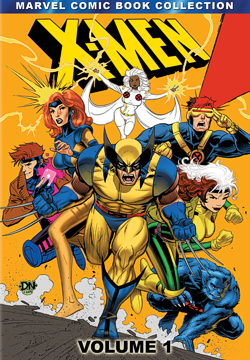
  • As you may have noticed from the image at left, the 1990s X-Men animated series is finally getting an official and complete DVD release! The details on the first two volumes have just been released, and they include 32 episodes in all. Read more here.

  • On the comics front, The New Mutants is back with a new series starring the original lineup of characters. If they'd get Bill Sienkiewicz and Chris Claremont back on the book, I'd be completely sold. Since there have been a few other revivals along the way that haven't worked out, I may reserve final judgment until I've read a few issues. Zeb Wells, who I just saw win an Annie Award as part of the Robot Chicken team a few weeks back, will write with Diogenes Neves (an artist whose work I'm not familiar with) will be on art.

  • Lastly, and perhaps most potentially cool of all, is news of a new comic series titled X-Men Forever, in which Claremont will continue the series from where he left off in 1991 as though all the intervening years never happened. While it sounds like he won't do all the cool stuff he had planned at the time, I think it'll be really fun to play What If? in this way. Tom Grummet is on the art, which I think is a solid choice and should be able to evoke the feel of the book back then and take it somewhere new. Now, if only they could talk Jim Lee into drawing an issue or two, my 1990s comics flashback would be complete. IGN talks to the mutant master about the series here.

Wednesday, February 4, 2009

Comic du jour: Ltd. Collector's Edition C-27 - Shazam!

In honor of today being my dad's 70th birthday, I'm going to review the first comic he and my mom ever procured for me: Limited Collector's Edition C-27, a treasury size Shazam! comic from 1974. I would have been about five when I got this comic, which I seem to recall arrived by mail order and would have been requested by me because of the Saturday morning TV show airing at the time.

Looking back at this, it's a pretty amazing first comic. Not only is it in the huge treasury format (80 pages for $1 must have seemed like a lot back then), but it reprints eight stories from the Golden Age run of Captain Marvel and the entire Marvel family.

The story that made the greatest impression on me was the Captain Marvel Jr. story, "The Man with 100 Heads!" There's a sequence where Dr. Slicer, the villain of the piece, captures Freddy Freeman and sets him, gagged, in a guillotine. Of course, Dr. Slicer leaves before the blade drops, and Freddy manages to get the gag free in just enough time to say Captain Marvel and save his neck — literally! Something about that scene captured my imagination and never let go.

I bought my current copy of the book a few years back — my original long since discarded and gone. Looking at this book again, I was impressed by the quality of the art and the liveliness of these stories. It also looks great. The reproduction on those treasury size pages is crisp, sharp and lovely to behold. This also was a great package for kids — there were puzzles, clip activities, a fairly sultry pinup of Mary Marvel, photos from the 1940s Captain Marvel serial and, best of all, the table-top diorama on the back cover. I'm pretty sure I cut up the back cover of my original copy to make this. Thankfully, now I can just make a copy with my scanner. Here's what the finished bit looks like:


Having tried to cut out all the bits around Billy Batson, I wonder if anyone at DC tried to see if a kid could do this well — or even safely — and get a good result. I'm not sure this looks a whole lot better than the one I did at age five, even with my now-obsolete paste-up skills. The final product looks a bit like the boxes those old Mego action figures came in.

Either way, it's still a brilliant comic and one of my favorites.

Thanks, Dad.

Tuesday, February 3, 2009

Mutant Cinema interview at CBR

Check out Timothy Callahan's interview with me about "Mutant Cinema," now up over at Comic Book Resources! (Be sure to check out Tim's book, "Grant Morrison: The Early Years." It's a terrific read ... ) Looks like an interesting discussion is forming on the CBR message boards about the merits of "X-Men: The Last Stand" ...

Also, the Facebook page has 24 fans and counting ... If you're not one of them yet, head on over and join up for all the latest updates.

Monday, February 2, 2009

Reed goes to Chicago, sets N.Y. show for fall

Reed Exhibitions, the company that puts on the New York Comic-Con, today announced the debut of its new show, Chicago Comic and Entertainment Expo (C2E2 for short), April 16-18, 2010.

They also are moving the New York show to the fall, with the next edition (after the one going on this weekend) set for Oct. 8-10, 2010. That's a long wait for the next New York show, but the fall dates are ones they will be able to consistently ensure going forward after having had to move around from February to April last year and back again to February this year.

This rather nicely settles down the convention calender, leaving WonderCon free and clear to do its thing in the early part of the year without having to compete with a New York show. (This year's show is set for Feb. 27-March 1 in San Francisco.)

But the biggest impact will obviously be on Wizard and its Wizard World shows. Wizard recently postponed its March show here in Los Angeles and canceled its Texas show. That left only the two summer shows on its tour, Philadelphia (June 19-21) and Chicago (Aug. 6-9).

What kind of impact the Reed show will have on WWChicago in particular will be interesting to watch. Wizard got into the convention business by buying in 1997 the Chicago Comic-Con, at the time the second-largest show after San Diego, and rebranding it as Wizard World.

Wizard's Chicago show is still the largest one they put on and a big show by any standard, but Reed's success in growing its New York show from 33,000 attendees in 2006 to 67,000 last year will make them tough to compete with. Reed also has more experience and greater resources to draw upon in marketing the show to the wider audiences that have made the New York show and San Diego more mainstream events.

Reed's also trying not to step on anyone's toes by finding clear spots on the schedule for its shows that don't force exhibitors to choose between shows or rush from one crazy con experience to the next with no break in between.

Thursday, January 29, 2009

'Mutant Cinema' in Previews! Arrives in stores April 29!

"Mutant Cinema: The X-Men Trilogy from Comics to Screen" is coming at last to comics shops!

The book is in the new edition of Previews, which arrived in comics shop this week, as a Featured Item! You can check out the solicitation online here. If you want to make sure to get a copy, ask your local comics shop to order you a copy using code FEB094600 by Feb. 14. The book is currently scheduled to ship April 29, which is perfectly situated right before the May 1 release of "X-Men Origins: Wolverine" on May 1 and Free Comic Book Day on May 2.

So the publicity push for the book is in high gear and I'll post all the relevant details here. First thing to watch for is an interview I did with Timothy Callahan for CBR. (And if you haven't read it yet, go grab a copy of his book, "Grant Morrison: The Early Years" for a great read.) An excerpt from the book should be coming soon, as well as a few chances to win a signed copy.

In the meantime, if you're on Facebook, check out the product page for the book, become a fan and learn even more about the book.

There will be more to come in the next few week — and if you've got a website, podcast or column, and want to talk to me about the book, please feel free to contact me via the email or AIM link on this page and I'll be happy to answer your questions.

Thursday, January 22, 2009

Why so serious, Oscar?

The nominees for the 81st annual Academy Awards were announced this morning. Yes, I was up at 5:30 a.m. PST to watch on TV and file a brief report for Animation Magazine.net. But reading the list itself was disappointing in the extreme.

Most of it came in the Best Picture/Best Director categories, which this year are for the exact same five movies, for which the choices are dull, boring and uninteresting.

Yes, a lot of his has to do with the exclusion of "The Dark Knight," "Wall-E" and even "Waltz with Bashir," all of which are superior movies that earned overwhelming critical, popular and commercial acclaim. (Yes, "Bashir’s" a little short on the commercial acclaim, but by the standards of films in its genres it already is a huge success.) And you’d think that kind of trifecta would have made an impact on the Academy.

Instead, what we’re left with is nominations for films that are decent but come up lacking in relevancy, entertainment value and even basic quality. But since they fit the Oscar mold and cater to the increasingly antiquated and odd predilections, they get the nod over material that genuinely entertained their audiences with stories that thrilled the heart and the mind.

So I just don’t get it. Especially the nomination of "The Reader," which hasn’t even been terribly well reviewed but has the double whammy makeup factor of a good performance from Kate Winslet (and, honestly, is she ever anything less than great in anything?) and a Holocaust connection (didn't the offensive inanity of "Life is Beautiful" cure of this weakness?).

But don’t take my word for it, let’s look at what the critics say as a whole on Metacritic.com and Rotten Tomatoes. (Yeah, it’s not perfect, but it’s a relatively level field from which to judge the overall critical reception of a movie.)

Metacritic posts the following marks for the best pic/director noms (in bold) and a few other popular contenders that missed the mark:

1. Wall-E — 93
2. Waltz With Bashir — 90
3. Slumdog Millionaire — 86 4. Milk — 84 5. The Dark Knight — 82
6. Rachel Getting Married — 82
7. Wrestler — 81
8. Frost/Nixon — 80 9. Iron Man — 79
10. The Curious Case of Benjamin Button — 69 11. The Reader — 58
And here’s what I found at Rotten Tomatoes for the same 11 pics:

1. The Wrestler — 98
2. Wall-E — 96
3. Slumdog Millionaire — 95 4. The Dark Knight — 94
5. Waltz With Bashir — 94
6. Iron Man — 93
7. Milk — 92 8. Frost/Nixon — 91 9. Rachel Getting Married — 88
10. The Curious Case of Benjamin Button — 72 11. The Reader— 60
What’s interesting about both is that "Benjamin Button," which lead all films with 13 nominations and is generally considered the film to beat, and "The Reader," are both at the bottom of these lists. For all the usual reasons, "Iron Man" was never in the mix, but "The Wrestler" and "Rachel Getting Married" would have made more sense than "The Reader."

"Wall-E" did pretty well by most standards, earning six nominations. But being an animated film means it’s chances of a best picture nom are completely undercut by the animated feature category — which it’s not even a sure bet to win. I have this sneaking suspicion that the actors branch, the largest in the academy, will be put off by the lack of dialog in the first half of "Wall-E" and go for one of the others.

"Waltz With Bashir" has much the same problem. Despite being a tremendously effective documentary and finding a completely unique and appropriate animation medium to tell its story in, it’s consigned not even to the ghetto of animated feature but to foreign film. Again, its not even guaranteed a decent shot at winning that category, which has become notorious for overlooking outstanding films in recent years. ("4 Months, 3 Weeks and 2 Days," anyone?)

Which brings us to "The Dark Knight." It’s hard not to think it was overlooked because it was a Batman/superhero/comic book movie. It’s really the only explanation. And choosing a mediocre bit of Oscar bait like "The Reader," a warmed over retelling of a marginal media event like "Frost/Nixon," or a beautifully crafted but emotionally hollow SF story — that no one involved with would admit is SF — like "Benjamin Button," and you’ve got a pretty good case that the Academy’s nominations flat out failed to represent the best filmmaking of the year.

Something I’ve long known but almost never been able to get anyone to talk about is the internal politics of the Oscars, which have become insular and restrictive enough to make die-hard Legion of Super-Heroes fans or 1990s X-Men continuity freaks look normal by comparison. A lot of academy members vote for films to support people they’d like to work with, to secure their next job or simply out of some distorted idea that they should vote for a film like "The Reader" just because its serious nature is inherently more valuable than anything a cartoon or a superhero movie could do.

And it’s that last prejudice that really sinks the noms choices, because it’s obvious that a lot of the most innovative filmmaking, a lot of the best work, the films that are connecting with their audiences in significant way, are films like "Dark Knight," "Waltz with Bashir" and "Wall-E." Like "Star Wars," which was passed over as best picture for "Annie Hall," or "Forrest Gump" trumping "Pulp Fiction," this will go down as one of those years of regret for the Academy. And their ratings will hurt because of it, no matter how good (or not) Hugh Jackman is as host. And if the Academy continues to nominate films that only fit its seemingly narrowing niche of acceptability, they risk tarnishing their image as the pre-eminent awards in the industry. It doesn’t take much to become a laughing stock — just ask the HFPA how much hurt that one Pia Zadora mistake inflicted and how long it took to heal.

There is hope, however, and it’s "Slumdog Millionaire." Thankfully, at least one of the films nominated for best pic/director has some energy, gets the blood pumping and actually has people excited to see it do well. Perhaps it’s a coincidence, but I don’t think it is, that director Danny Boyle has eclectic tastes and has made great movies in all kinds of genres, including "28 Days Later" (horror) and "Sunshine" (sci-fi — I may be the only one, but I liked it).

So if I could give one message to the academy, it’d be: Why so serious? Relax. Enjoy going to the movies. And for God’s sake, get over your English teacher. Movies don’t have to adapt Proust, Hemingway, Dickens, the Bible or Faulkner to be serious entertainment. Let movies be movies, and remember — this is supposed to be fun, but it's also supposed to be a process that honorably searches out and rewards the best filmmaking of the year, regardless of genre or medium of origin.

Tuesday, January 20, 2009

Comic du jour: Detective Comics #437 (Nov. 1973)

I was visiting flea markets again this past weekend and came across a good deal on this classic issue of Detective Comics.

Was there ever a better time to be a Batman fan that the early 1970s? You had Denny O'Neil and Neal Adams doing their classic thing. And then there was this issue, the first edited and written by Archie Goodwin and featuring art by Jim Aparo and the first installment of "Manhunter" with art from then-newcomer Walt Simonson.

The lead story is a solid Batman detective story in which the Caped Crusader stumbles across and foils an elaborate criminal blackmail plan revolving around a mysterious artifact in a Gotham museum. (I'd like to know how often the Gotham museum cliche has been used in Batman stories over the years – I'd guess it's in the top five.) But this is a solid, complete story told in a mere 12 pages. Aparo is one of those workman-like artists who never got the acclaim that guys like Adams or Simonson did, but he should have. Looking at the quality of both his storytelling and his illustrations, this is top-notch stuff. There's even a stellar "silent" action sequence on page 2, in which Batman dispatches a group of rooftop thieves in an economical and compelling eight-panel layout. And Aparo still was a top-notch Batman artist more than 16 years later, when I first started reading his work on such seminal 1980s Batman stories as "10 Nights of the Beast," "A Death in the Family" and "A Lonely Place of Dying."

The backup story is known as a tried and true classic. I have a trade collecting the Goodwin-Simonson "Manhunter" stories, and they are definitive of the best comics of this era. Simonson remains one of my all-time favorite comics artists, mostly for his work on Thor, X-Factor, Star Wars and even Marvel's old Battlestar Galactica series, (which I believe gave him his first credits as a writer). Seeing these stories from early in his career, it's remarkable to see how consistent his distinctive art style has been, even as he improved his storytelling and drawing abilities in quite significant ways over the years.

Even more interesting is the letters page in this issue, in which Goodwin introduces himself as the successor to Julie Schwartz and outlines his plans for reviving Detective. (At the time, the book's sales were slumping and the series was being published bimonthly! I don't know how long this lasted, but I'm sure the quality of issues like this one helped turn that around.)

The weakest point of the whole package is, surprisingly, the cover. It looks like Aparo to me, but the illustration is poorly composed and completely overwhelmed by a design that overemphasizes the logo and trade dress. Even so, with regular comics today about to reach en masse the $3.99 price mark, this comic was a tremendously entertaining bargain, even at the princely sum (in 1973) of 20 cents.

Comics slowdown emerges in stores, new Diamond policies

So the general economic troubles have started to have a concrete impact on the comic book business. Take, for example, this article from today's Los Angeles Times, which says more fans are reading trade paperbacks through their local libraries rather than buying them, and notes the overall downturn in the direct market:
But even after a year stuffed with blockbuster films based on comic books, growth in all sectors is stalling.

There are no statistics available for comic books sold to customers. But the number sold to merchants is dropping. For February through November of 2008, the amount of top comic books sold to shops was lower than the same period in 2007, according to online research group Comics Chronicles.

Sales figures in broader comics categories, including magazines and trade paperbacks, nonetheless increased in the January-through-November period, though just 0.5% more than a year earlier, said John Jackson Miller, a Comics Chronicles researcher.
The article also discusses the impact of piracy and mentions the recent postponement of Wizard World Los Angeles. On a good note, it seems as though the Third Planet store in Torrance has been given a bit of reprieve:
Dreary sales forced Third Planet Games & Comics in Torrance to shut its doors in early January.

But in true superhero fashion, a longtime customer saved the day by buying the business.

The store will reopen with a smaller staff and stricter standards for ordering, manager Scott Grunewald said.

"Hopefully we have a happy ending," he said. "Because now, we're starting from scratch."
On top of this comes the news of policy changes at Diamond Comics Distributors that raise the performance bar for new products — and will certainly put the squeeze on, especially, small publishers. The Beat has all the particulars, including on-the-record comments from Joe Nozemack at Oni Press. Here's the gist, from The Beat:

In a change that will have a far greater impact, according to numerous reports, Diamond is raising its benchmark for products it will carry from $1500 to $2500. Jones has the clearest explanation of this change, (although he later amends perhaps the most key point of all) but the short version is that unless orders to Diamond on a product are consistently greater than $2500 at wholesale, Diamond will no longer carry the product.

The obvious result is that a lot of publishers in the back part of the Previews catalog will likely be dropped, limiting their ability to publish at all. This may not seem like a huge loss at first, but as pointed out on a number of sites, things that have become classics like Bone or even 30 Days of Night might never have been published with the new standards in place.

Being the optimistic guy I am, I wonder if this doesn't perhaps open up an opportunity for secondary distributors like Haven (formerly Cold Cut) to add more titles and specialize in the sort of indie titles that are being dropped. Sure, lots of stores won't add a second distributor to their workload and expenses in tough times, but low-fi indie work has a long tradition in the direct market that may now have a bit of a fire lit under it by the Diamond actions.

Friday, January 16, 2009

'Watchmen' dispute settled

Fans can relax: Watchmen will hit theaters March 6 as planned now that Fox and Warner Bros. have settled their rights dispute. Here's Variety's story, THR's and Nikki Finke with some of the details of the deal.

Details include a cash payment from WB to Fox and the latter having gross participation in the film. But Fox won't distribute the film, nor will its logo appear on it.

Frankly, this really was the only possible outcome, and all the drama can be forgotten.

The only thing that's even a little worrisome is that Fox got as part of the deal a stake in any spinoffs or sequels — neither of which I think any fan of the book really wants to see.

Wednesday, January 14, 2009

Comic du jour: Space: 1999 #6 (Sept. 1976)

I realize this is the second John Byrne comics I've picked for this feature in a week, but I just came across this one and couldn't resist for a number of reasons.

First, I loved the "Space: 1999" TV show when it was first on the air back in 1976 or 1977. It aired on ITV in Edmonton in the afternoons on Tuesday and Thursday, while "Star Trek" filled the same slot the rest of the week — making it perfect after-school viewing for a space fan in those pre-"Star Wars" days. The show seemed much cooler than it really was — especially now that I've revisited it on DVD — but the visual effects were terrific for the times, the Eagle was one of the coolest space ship designs ever, and this show had a great opening title sequence and theme.

Second, I bought this Charlton Comic off the stands when it came out and loved it for having all the action that the show promised but never really delived. The story is simple — an alien warrior whose ship is the size of an apple and more powerful than a small star slams into an Eagle on patrol and splits it in half. Commander Koenig, in the middle of the ship when this happens, is sucked out into space. There's this great sequence where Koenig's holding his breath as he twists and turns in zero gravity to try to reach his helmet. Byrne, who wrote and drew this tale, presents a great double page spread of 10 vertical panels of Koenig reaching for the helmet, counting down to the moment when Koenig's lungs will burst. He grabs the helmet, of course, and manages to turn the back half of the Eagle into a flaring pinwheel that alerts his fellow Alphans to their location and they're soon rescued. Simple, but cool.

Byrne's art is the reason this whole thing works. All the elements that would in short order make him the most popular artist in the industry are here — in the inventive design of the alien, the detailed technology of the alien ship and the clean, sharp look of the Alphans' ship and base.

It was about eight or nine years after this that I had returned to comics as a teenager and learned that Byrne was living just down the road in Calgary when he did this issue — a fact that surely would have impressed me to no end at the time I first read it.

The TV series remains a guilty pleasure for me — I own every episode from both seasons on DVD — but this comic remains my favorite Space: 1999 story and one of my favorite Byrne comics.

Tuesday, January 13, 2009

Comic(s) du jour: City of Dust #1-3 (Oct.-Dec. 2008)

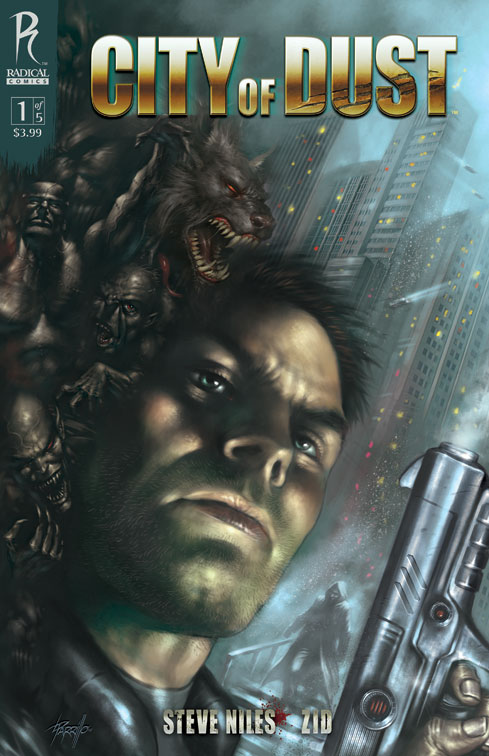
Writer Steve Niles throws a pretty good twist into this five-issue series from Radical Comics. This starts off following the footsteps of Ray Bradbury's classic "Fahrenheit 451," introducing future copper Philip Khrome patrolling a future in which stories, religion and books are all banned. Khrome's a dutiful cop, doing his duty by the book. But the twist — the twist! — comes out of left field (at the end of the second issue, no less) and really makes you sit up and notice. Perhaps given Niles' track record as the creator of "30 Days of Night" (the comic rocks, even though the movie definitely does not), it shouldn't have surprised me, but it did.

The art on the first two issues of this are by the mono-named Zid, with Brandon Chng and a few others chipping in. It follows the Radical style, which is rapidly becoming a house style. It's a generally attractive, fully painted look that is dark and moody and looks in some way heavily processed. It reminds me of the look of the film "Beowulf," which was dank and murky. That film also had detail, which is something that some more traditional comic line art could add.

I don't know how much life this has beyond this initial five issues, but for now it's a nice injection of coolness into the comic scene.