Friday, February 25, 2011

What awards mean, with a detour through the Eisners — plus Oscar picks!

I'm going to use the 83rd annual Academy Awards, which are being presented this Sunday (in case you didn't know) as an excuse to talk a bit about awards in general and to make my picks for the winners this year.

First of all, I have my own rule about awards and their significance: The only thing any award signifies is the opinion of the people giving it at the time they're making that choice. It means nothing else. This means it's nice to win, but I'm not going to stop liking a movie I already admire if it doesn't win, and some movies can get all the awards in the universe and still be, in my opinion, complete crap.

That said, the thing that makes some awards more special than others comes down to who is presenting the award and the exclusivity of the award. The Oscars are a great example of both. Winners have the satisfaction of knowing that the industry — people who know what they're doing when it comes to making movies — admire their work. They also know that these awards are exclusive and subject to rules that are (for the most part) fair and inclusive of all the work that's been done in a particular year.

The exclusivity part is best illustrated by what happens when awards are not exclusive. For example, each year only five actors get nominated for best performance by an actor in a leading role, and only one wins. This means out of hundreds of potential choices, only one per year gets to take home the statue. That's a tough choice for people to make, but it usually means the winner has done something interesting or unusual to earn it. But if you started to, say, split the category up and award a best actor in a drama and a best actor in a comedy and maybe a best voice acting performance for animation, then the exclusivity of winning a best actor Oscar is diminished and it's not going to be as special. You would always end up with a debate over which of the multiple winners was the best and slights against someone who wins who others will say deserves it slightly less than another of the winners. So keeping the awards exclusive like this is something the Academy wisely resists, and there is a ton of pressure put on them to add more categories because the publicity and marketing machinery of Hollywood would love to have more races to run and those magical "Oscar Nominee" or "Oscar Winner" labels to slap on ads and DVD cases.

To bring this back to comics, when I was a judge for the Eisner awards back in 2005, there were a lot of discussions at the start of the judging process about whether we wanted to add, delete or merge categories. I resisted and argued against adding new categories, and against instances of expanding the number of nominees precisely because doing so undermines the exclusivity (and therefore the prestige) of the awards. Also, I thought making those tough choices was what we had signed on to do, so failing to whittle down the number of nominees to the typical five just because we couldn't bring ourselves to make a hard choice between two nominees was a cop out.

The one award I argued most vehemently against adding was one for best reality-based comic. My rationale was that comics don't really do nonfiction. You can stories based on real events, to be sure, but it always has to be adapted into a narrative and filtered through the creators into a form that is otherwise indistinguishable from any other comic. Prose and film can do nonfiction — you can present facts and make a case in both of those media without having to turn it into a story. In film, you can show directly people speaking, places and events as they happen. In prose, you can describe and relate the same sorts of items in a detached, third-person and factual manner. In comics, you just can't do that and still have the comic book medium be the best way to communicate the points you're trying to make. The most obvious case for this is Scott McCloud's Understanding Comics, which is essentially an academic paper on the mechanics of comics done in comic book form. And for that, McCloud had to re-create himself as a character who narrated the chapters and moved through them in a linear fashion that essentially turned each part of the book into a narrative story. So, I argued against it and won the point. It lasted all of a years — the next year's group of judges felt differently and went right ahead and added the category.

The other trick for legitimizing your awards is to make sure that they are presented for specific works rather than to a person. If you look at the fine print, you'll see the Oscar's don't give an award for best actor, but for best performance by an actor in a leading role. Voters are choosing a specific work, which is different from voting for a person as best actor. If I think that, say, Jack Nicholson is the best actor every year and he's not in a movie this year (or not in one that stands out enough for awards attention) it would still be intellectually honest to vote for him as best actor, which would not be the case if the award is for best performance by an actor. It's a difference that gets easily glossed over, but I think it's an important one.

On to the fun part: My picks for this year's Oscars. (FYI, for folks needing help with their Oscar pool ballots: my track record in picking these things is not very good, so follow my picks at your own risk.)

Best Picture

  • Should win: Toy Story 3. I admit, I'm biased, having covered it extensively, but I still think of the nominees this was the most all-around entertaining and well-made movie I've seen all year. 
  • Will win: The King's Speech. This is a good movie, and it's pure Oscar bait. And I'd like to think the academy is too smart to give it to The Social Network, which was good but not the groundbreaking film everyone seems to think it is. I think they're confusing the importance of Facebook in people's lives for the movie itself being important.

Best Director

  • Should win: Joel and Ethan Coen. They're always great, but of all the noms, True Grit was the one film that I think would have been completely different and far less interesting in the hands of any other helmer.
  • Will win: Tom Hooper. See above.
Best Actor

  • Should win: Javier Bardem (Biutiful). Is this guy ever less than excellent? Nope.
  • Will win: Colin Firth (The King's Speech). This is an excellent performance, and it will triumph because it also hits all the Academy's biases.

Best Actress

  • Should win: Natalie Portman (Black Swan). 
  • Will Win: Portman. This is in a class by itself this year.
Best Supporting Actor

  • Should win: Christian Bale (The Fighter)
  • Will win: Bale. Again, nothing else is as memorable as Bale's Boston junkie.
Best Supporting Actress

  • Should win: Helena Bonham Carter (The King's Speech). I think she's horribly underrated in Oscar circles. She's always fantastic and was especially superb in this role. I usually love anything Amy Adams is in, but this wasn't her best role. Steinfeld would be my second choice — her performance was as essential to True Grit as Bridges.
  • Will win: Melissa Leo (The Fighter). She's very good, though I think her role is a bit too supporting in that the real conflict in that movie was between the brothers. Her role is not what I remember when I think of this movie.
Original Screenplay

  • Should win: Inception. I really dug this movie and felt it successfully pulled off more daring writing stunts than any other movie this year.
  • Will win: The Kids Are All Right. This movie was written about ad nauseum when it first came out here in L.A., so I'm sure it will win something and this is it. 
Adapted Screenplay

  • Should win: Toy Story 3. Again, I'm biased. I think Michael Arndt did a great job on this script.
  • Will win: The Social Network. Everyone loves Aaron Sorkin for some reason.
Best Animated Film

  • Should win: How to Train Your Dragon. As great as Toy Story 3 is, I really loved this movie. Plus, I think it has a strong chance to pull off an upset, a la Happy Feet beats Cars.
  • Will win: Toy Story 3. By nominating it for best picture, it's nevertheless pretty clear how the Academy feels about this movie.

Best Foreign Film

  • Should win: Biutiful (Mexico). 
  • Will win: Biutiful. This is one of those wild card categories, plus I admit to not having seen all of these. But Alejandro Gonzalez Inarritu makes fantastic movies and I am hard pressed to imagine any of the others surpassing it.
Best Art Direction

  • Should win: Inception.
  • Will win: Inception. I can see Alice in Wonderland or The King's Speech playing spoiler, but the production design on this is  pretty spectacular. Plus, Guy Hendrix Dyas is a great guy and he deserves it.
Achievement in Cinematography

  • Should win: True Grit. Roger Deakins 
  • Will win: Deakins. Everyone loves his work, and this film really looks spectacular. 
Achievement in costume design

  • Should win: The King's Speech, Jenny Beavan. I don't always notice the costumes when they're trying to be subtle, but I thought the costumes were used to excellent effect in this movie. I noticed what the actors were wearing without it being distracting at all.
  • Will win: Alice in Wonderland, Colleen Atwood. This is just a hunch, but the outfits in this were pretty spectacular and splashy in the way the academy sometimes likes to reward.
Best Documentary Feature

  • Should win: Inside Job. If you haven't seen this yet, it is the definition of a must-see. If you don't leave the theaters absolutely enraged, then something's wrong with you. 
  • Will win: Exit Through the Gift Shop. This was a great year for docs, and this is easily one of the most bizarre and fascinating stories put to film.
Best documentary short subject

  • I have to pass on this one, because I've not seen any of the nominees.

Achievement in film editing

  • Should win: The King's Speech, Tariq Anwar
  • Will win: Anwar. This was beautifully edited, with much of its power coming from the pacing that Anwar gives it. 
Achievement in makeup

  • Should win: The Wolfman, Rick Baker and Dave Elsey. Come on, it's Rick Baker! He's the whole reason this movie got made.
  • Will win: Barney's Version, Adrien Morot. But the Academy won't go for a werewolf movie, so I guess this will win.
Achievement in music written for motion pictures (Original score)

  • Should win: How to Train Your Dragon. John Powell
  • Will win: Powell. Hollywood has really taken to this score — and for good reason. 
Achievement in music written for motion pictures (Original song)

  • Should win: "We Belong Together" from Toy Story 3. Music and lyric by Randy Newman. 
  • Will win: Newman. This one sticks with you long after you leave the theater. And Hollywood loves Randy Newman. 
Best animated short film

  • Should win: Day & Night. Teddy Newton.
  • Will win: Day & Night. The others are really well done films, but this was a terrific idea that works only in animation and really only in 3D. It may be the only 3D movie to come out this year where the 3D is truly essential to the experience.
Best live action short film

  • Again, I have to pass, having seen none of these. Look for tips on your Oscar pool elsewhere.

Achievement in sound editing

  • Should win: Toy Story 3. Great stuff.
  • Will win: Tron: Legacy. This one usually goes to a big effects movie and the sound work in Tron was very strong. 
Achievement in sound mixing

  • Should win: True Grit. Skip Lievsay, Craig Berkey, Greg Orloff and Peter F. Kurland. 
  • Will win: True Grit. I can still hear this movie in my head, so good job.
Achievement in visual effects

  • Should win: Inception. Paul Franklin, Chris Corbould, Andrew Lockley and Peter Bebb.
  • Will win: Inception. There was no cooler image in a movie this year than Paris bending. I think that will edge out the sequels in contention, while Alice in Wonderland isn't as seamless and Hereafter just plain lacks the volume of shots.

Tuesday, February 22, 2011

A Brief Remembrance of Dwayne McDuffie

Comic book and animation writer Dwayne McDuffie has passed away, according to reports on all the major comics news sites. This is unexpected and tragic — McDuffie scripted the All-Star Superman animated movie that comes out today and appeared last week at the movie's premiere event.

McDuffie also was the first comic book professional I got to interview for an article. In my first job out of college, I worked as the special sections editor at the Arizona Daily Sun in Flagstaff, Ariz. One of the special sections I was in charge of was a weekly tabloid section called Sundial. It was a weekly tabloid section that included the TV listings and about 13 pages of editorial content for arts and entertainment news. This was the only regular arts section of the paper, for which hard news and sports were the main focus. I wrote each week a couple of features and a bunch of shorter articles and a calendar for this section, filling the rest with relevant wire copy about what was going on in the TV, movie and book worlds.

I was totally into comics but felt my primary focus had to be on local arts. I didn't write anything about comics for almost a year, until the Death of Superman became a super hot topic everyone in town was talking about. So I dove in and wrote a long piece on the history of Superman. I was in touch with Martha Thomases, who was in charge of publicity at DC Comics at the time, and she helped me out with some reference materials and even a few advance copies of issues in the Death of Superman storyline. She refused my interview requests, however, saying the writers and editors were all off on retreat figuring out the next steps in the Superman story. I relate this only to explain how I got on the DC press list, so that when Milestone Media was launching a few months later, I got the press kit and thought it would be fun to fill my writing quota with a story about this new line of comics.

So Thomases arranged a phone interview with McDuffie, who I recall as being a very good interview in that he knew what he was talking about and very easy to talk to. We took a couple of diversions to talk about other things he had done and what was going on in comics in general. And the resulting article was published in the Feb. 20, 1993, edition of the Sun.

I have scanned in the story and present it below as a PDF. There are a couple of typos and punctuation errors, but re-reading it stands up pretty well overall. Read and enjoy.

mcduff1

There is a post-script to this story. That year was the first year I made the trip out to San Diego for Comic-Con. And while I was there, I ran into Thomases at the DC booth and she introduced me to McDuffie, who was signing Milestone trading cards. We had a nice little chat, he talked about how well Milestone was doing (so far) and he handed me a couple of signed cards to take away (I still have it, somewhere).

I've sort of bumped into Dwayne or seen him from across the room at many cons since then. As I've written more about animation, I've seen some of the shows he's written and enjoyed them. I've also been impressed by his ability to stand up and tell the truth about the portrayal of minorities in comics and the way the business operates.

I'm sorry to hear he's gone. He'll be missed.

Tuesday, February 15, 2011

Getting Superman back on track

Superman is easily the most difficult major comic book character to nail down. He’s been through dozens of different interpretations — in comics and in other media. And he’s been revamped and rebooted more times than just about any other comic book character out there, and still falls short of expectations on a pretty large scale.

For the past 25 years, the Superman who appears in the pages of DC Comics has faced the law of diminishing returns when it comes to reboots. The 1986 reboot that began with Alan Moore’s "Whatever Happened to the Man of Tomorrow?" and continued into John Byrne’s Man of Steel was a solid success. It revitalized interest in the character, got a lot of mainstream press attention at a time when that was unusual for comics and even sold a lot of comic books for DC. Today, however, the time between reboots has dwindled from decades to years to what seems like months. Just in the past few years, DC has published a Secret Origin miniseries by Geoff Johns and Gary Frank, J. Michael Straczynski’s Superman: Earth One original graphic novel. The main Superman books have also struggled to find a direction, with the long “New Krypton” concept giving way to Straczynski’s controversial “Grounded” storyline.

I read Earth One and I’ve read “Grounded,” and found both immensely disappointing, just as I found some of the spark that made Superman great in DC’s reissue of Superman vs. Muhammad Ali and in the earliest Superman stories as presented in The Superman Chronicles, Vol. 1.

Earth One has at its core the same idea Marvel had 10 years ago when it started the Ultimate line: Create a new, continuity-free version of the classic character with a modern, updated origin and style designed to hook the young readers that have made huge hits out of Harry Potter and Twilight. Like the Ultimate imprint, Earth One is ideally meant for a mainstream audience and not for the die-hard fans that frequent the comic shop each Wednesday.

This is an approach that can work, can generate some excitement. The early days of Ultimate Spider-Man in particular helped turn Brian Michael Bendis into a blockbuster comic book writer. Interestingly, the Ultimate line ended up being a hit in the direct market more than with the mainstream audience it was created for.

But where the early Ultimate comics brought energy and some inspired tweaks to established lore, Superman: Earth One lacks passion and reads like something created more to meet a marketing plan than to entertain. This version of the tale recasts young Clark Kent as an indecisive youth who heads into the big city with no idea of whether he’s going to be a scientist curing cancer or maybe a reporter at the Daily Planet. Then the aliens show up and he becomes Superman to fend it off — mostly because no one else can.

The main creative innovation seems to be to make Clark more “emo.” He mopes a lot, wears a hoodie, listens to his iPod and doesn’t comb his hair. Similarly, Lois is drawn to so closely resemble actress Jennifer Carpenter from Dexter that it’s plausible that the artist used a DVD set as photo reference.

Either way, there’s little joy in this tale, a point driven home by the grim, muted color palate. Clark is never happy and rarely cracks a smile. Lois never does anything to suggest why anyone would find her attractive. And the villains of he piece appear completely pieced together from other sources — the alien invasion rehashes the well-worn material of Independence Day and the villain, Tyrell, looks like Lobo’s stunt double. In the end, despite the grand pronouncements, press releases and interviews, there’s little sign that this could develop into a compelling vision of any kind for the Man of Steel.

It’s not even clear to me how this is supposed to make the character more appealing to young readers. To suggest that young readers will “see themselves” in so bland and cynical a revamp is insulting.

And yet, this book sold so well that another round of pronouncements appeared trumpeting the news that a sequel is in the works — though I suspect the sequel was already in the works and DC would have made a media fuss about it no matter how well the book actually sold.

It’s a similar problem with “Grounded,” which has been met with a lot less enthusiasm than Earth One. In many corners, this story has been roundly mocked as Superman gets sad and walks across America. The criticisms are well deserved — this is a bad idea, poorly executed (for the most part). It has some of the same problems as Earth One. This Superman also is unsure of himself, reluctant to act and fumbling around for answers. Unlike the Superman in Earth One, however, this version lacks the excuse of being an inexperienced youth to counter it. Instead, he just comes off as weak and indecisive — hardly heroic qualities. There really shouldn’t be this much crying in a Superman comic.

So what does work when it comes to Superman? There are some answers in Superman vs. Muhammed Ali, which DC recently reprinted for the first time since it first came out in 1978. This is easily one of my favorite comics of all time, because it’s just so damn cool. Aside from being the best art job Neal Adams ever did, this tale is proud to be a comic book and tells the kind of fun, crazy tale that can really only be told in a comic book.


This version of Superman is undoubtedly a hero and spends most of the book doing a lot of really amazing things. There’s spaceships to fight, natural disasters to avert, giant robots to duke it out with — even a bit of super-disguise in a key plot point. Oh yeah, and the fight of the century, complete with an all-star list of celebrities rendered with great detail on that amazing Neal Adams cover. (Side note: I was surprised the new edition didn’t identify Stan Lee on the cover. He’s clearly there, down in front, just to the right of Lex Luthor’s head. I mean, I can see DC not doing so at the time, but 30 years on it just seems like the record should be set straight.) I never tire of look at this book, though I still prefer my high-grade copy of the original to the new coloring and glossy paper of the reprint.

Going back even further, there is tremendous joy and a lot of fun to be found in the pages of The Superman Chronicles, Vol. 1. This series of trades reprints in color the Golden Age tales of the Man of Steel in chronological order. This first volume collects the Superman stories from the first 13 issues of Action Comics, New York World’s Fair Comics #1 and Superman #1. It’s easy to see why Superman was an instant hit in 1938 — these are bouncy, fast-paced and really fun stories.

And it’s extremely informative to see Superman stripped of some of his familiar elements. There’s no Jimmy Olsen, no Smallville or Ma and Pa Kent. Clark Kent works for the Cleveland Daily Star, not the Daily Planet of Metropolis. And long before Superman was fighting for “truth, justice and the American way” (whatever that means), he was “champion of the oppressed.” This Superman used his powers to take on and beat such threats as crooked politicians, war profiteers, mobsters fixing sports events, businessmen who ignored unsafe working conditions, swindlers selling worthless real estate and more. There’s no question in these stories that Superman is right to take on these kinds of real-world issues, and for the kids lucky enough to read these when they first came this must have been like dynamite. Today, of course, there would be no chance Superman would take on these kind of real world villains because the strange nature of American politics would make such stories into manufactured controversies.

Here’s a few other things that reading these stories have made clear about this character:

1. Superman works best when Superman is the real character and Clark Kent is the disguise. For some reason, the comics (such as Earth One) have increasingly moved toward making Superman the alter ego of Clark Kent. Yet I’ve never seen a version of this approach that works. To look outside of comics, the Superman of the classic Fleischer brothers’ cartoons and Christopher Reeve’s portrayal in the 1978 movie and its good sequel are beyond clear that Kent is the disguise. Pretty much every superhero that came after Superman has played the heroic role as the alter ego of the secret identity. So why make Superman just like everyone else?

2. The focus of a good Superman story is on Superman doing super stuff. The character has accumulated a large supporting cast including not just Lois Lane, but also Jimmy Olsen, Perry White, Ma and Pa Kent, Lex Luthor, Lana Lang, etc. And too often it feels like writers are trying too hard to fit as many of these characters into every Superman story at the expense of a focus on the Man of Steel himself. How about not using Jimmy et al. too much for a while and see if anyone really does miss them?

3. Superman should return to being “champion of the oppressed.” I think it would be very interesting to set Superman against some of the oppressors of the modern world. Yeah, it would be controversial, something DC has historically avoided with Superman. But comics are often at their best when — like good rock ’n’ roll — they’re subversive, challenging the reader by doing something different. There’s not much of this spirit left in comics, especially in corporate superhero comics.

Lastly, I had most of this post drafted when I learned of the death of Joanne Siegel, widow of Superman co-creator Jerry Siegel. I never met her, but by all accounts, she was a pretty amazing woman.

Thursday, February 3, 2011

Comics I like: L&R, Zot!, Next Men, X-Men Index, New York Five, 27, Who is Jake Ellis?

I have several large stacks of comics on my desk right now, including a bunch of current superhero releases from Marvel and DC. Some of these are not recent releases, but most are, and indicate where my head is in terms of comics these days.

Love and Rockets: New Stories #3 (Fantagraphics, 104 pages, black and white, $14.99) contains one of the best comics stories I've read in a very long time: Jamie Hernandez's "Browntown." It fills in the history of Maggie's family with a story that is realistic, honest and true in every way that matters. Throw in a tale of "current day" Maggie, and some fantastic sex weirdness from Gilbert, and this easily is the best $15 you can spend in a comics shop.

Zot!: The Complete Black and White Collection (Harper, 576 pages, black and white, $24.95) is really interesting to read for the first time so many years after having absorbed Scott McCloud's most famous work, Understanding Comics. That's because he obviously is experimenting with some of the ideas for comics storytelling he eventually put into Understanding Comics, and it's interesting to see those ideas put into practice with a real story. What I didn't expect from this book was how gentle and sweet it is, and how well McCloud's art style fits with the story. It's also a big, thick and satisfying read — complete with commentary by McCloud on each story. Another excellent read for a great price.


John Byrne's Next Men #(3)1 and (3)2 (IDW, 28 pages each, color, $3.99 each) were a pleasant surprise. I have been a fan of Byrne's work for many years and I thought his original run on Next Men was easily the best, most original thing he had ever done. I love a lot of the work he's done for DC and Marvel superheroes, but Next Men really stood out to me as the kind of comic top creators should be free to do. Having just re-read the entire original Dark Horse run prior to digging into the new issues only reinforced this in my mind, and I really think that the series would have been a huge smash and run for years had Image Comics and the speculator phenomenon not come along at the same time. But I have to admit disappointment in Byrne's recent work — especially such DC projects as the unreadable Lab Rats and underwhelming takes on Doom Patrol and The Demon. I haven't read his previous IDW stuff. But the first two issues of the revived Next Men really popped — the story picked up seamlessly and with plenty of surprises, and the art recalls Byrne's style from the time he did the original series and is more inviting and stylish than anything I've seen from him in years. I'm glad Byrne finally came back to this series and hope it's successful enough to encourage him to try more creator-owned material in this vein.

The Official Marvel Index to The Uncanny X-Men (Marvel, color, $19.99). I have always liked these indexes because it's a lot of fun to just flip through info on so many series in one convenient place. This is a complete revamp from the previous X-Men indices (published in 1987-89 and 1994), and while I like that things like variant covers and some behind-the-scenes creative notes are included, I do have a few complaints: Please, Marvel, number the pages — especially if you're going to say in the text things like "This issue has a 2nd printing variant cover, which can be seen on p. 165." Because I can't find p. 165 with no page numbers short of flipping through the book until I spot what I'm looking for. Second, I know space is tight, but using abbreviations for every title is a bit annoying even as I like that you added a year to each issue cited in this way. And lastly, if you're going to index the X-Men, it would be useful to treat the X-Men in the index the same way Marvel publishes the comics: As a line of comics. It's especially annoying when you have so many crossovers between The Uncanny X-Men and X-Men, and the index only includes the Uncanny side. I would hope a second volume is on the way to fill in those gaps. Still, I'm glad to have this and pleased is goes all the way up through 2009's Utopia crossover.

Back to singles: The New York Five #1 (DC/Vertigo, 32 pages, black and white, $2.99) surprised me by being a lot better than I remember The New York Four being. This sequel from writer Brian Wood and artist Ryan Kelly — about a group of young women finding their way through their freshman year at college in New York City — feels more appropriate to a college age than the younger first book. The full-size comic book format also lets Kelly's artwork really shine — it looks fantastic in all its detailed, gritty, urban black and white glory.

I picked up 27 #1 (Image Comics, 24 pages, color, $3.99) as part of an effort on my part to find something — anything — new to get excited about. And it's a good start. Scripted by Charles Soule with art by Renzo Podesta, this is a tale of a rock guitar god whose hand injury has put his career on the rocks. Until an unusual solution is offered that has its drawbacks. Printed in a slightly oversize "Golden Age" format, the art looks like it was actually drawn (instead of the heavily Photoshopped
 Lastly, I snagged a copy of Who is Jake Ellis? #1 (Image Comics, 28 pages, color, $2.99), which presents an unusual take on the well-worn spy drama. Written by Nathan Edmondson, our titular hero is a spy who has a sort of imaginary friend who warns and advises him on how to do his job and get out of the sticky situations it lands him in. It's not clear either to Ellis or the reader exactly what this presence is, but it is nice (again) to read a first issue that presents enough of a new story to make me feel like I got my $3 worth. The art, by Tonci Zonjic, is clear, atmospheric and well-colored, making for a nicely designed package.

Tuesday, February 1, 2011

FF Re-read: The Fantastic Four #7 (Oct. 1962)


“Prisoners of Kurrgo, Master of Planet X!” 

Script by Stan Lee 
Pencils by Jack Kirby 
Inks by Dick Ayers 


While issue #6 is one of the best early issues of Fantastic Four, issue #7 is one of my least favorites. While the previous issue had a complete and compelling story featuring villains we’ve already met and care about, this was an episodic mish-mosh of old ideas and clichés that doesn’t add up to much. Despite those flaws, it’s not a horrible issue — it just feels like filler. Perhaps this had to do with the series going from a bimonthly to a monthly publication schedule, and Lee and Kirby had to crank this issue out quickly.


This one starts with Kurrgo, who’s the sort of character that populated a lot of the pre-hero Atlas series. An alien whose planet faces destruction from an asteroid on a collision course, he thinks the Fantastic Four can save his people.


Then we cut to the banter-filled intro of our heroes, who this time are quarrelling over a “government dinner” being held in their honor that no one except Reed is interested in attending. The strange reasons they all have for not wanting to go prompt even stuffy ol’ Reed Richards to roll his eyes in one panel. This sequence segues into a scene where Johnny takes a shower and Ben cranks up the hot water as a joke. Johnny flames on and turns the water to steam, setting off alarms. Reed uses his powers to check all the vents before he puts two and two together and realizes the junior members are horsing around again. Finally, they all head off to the dinner in the Fantasti-car, waving at folks on the road below. All this is a kind of fun character bit, though it also feels like definite filler and a scene that goes nowhere. It also lacks the polish similar scenes in the previous issues have.

When Kurrgo’s ship finally arrives, Lee and Kirby have a giant robot emerge using images ripped straight out of the classic movie The Day the Earth Stood Still. The plot gets even more weirdly complicated as the robot sends out a “hostility ray” that turns everyone on Earth against the Fantastic Four. The heroes themselves see the effect take hold in the midst of their “government dinner” with members of Congress and have to escape the Capitol building and get back to the Baxter Building. Kurrgo’s robot awaits them at their HQ and tells them the only way out is for them to go with him to Planet X and help Kurrgo save it. They agree, and head off into space.


Up to this point, Kirby’s art this issue is serviceable but lacking the impact that the previous issue did. The fourth part of this story, however, changes that with a great splash on page 15 with the Fantastic Four floating toward the ground in a futuristic city using and anti-gravity device of some kind. The splash for part 5 of this story is another great one that foreshadows the kinds of compositions and designs that would define Kirby’s amazing work in the late 1960s and 1970s.

The story remains a bit of a mess as the Fantastic Four meet Kurrgo for some exposition about how Planet X only has two spaceships and needs to save its 5 billion inhabitants from the asteroid that’s going to hit in 24 hours. There’s an obligatory and strange fight scene that ends as Reed agrees to help. The solution is a pretty good comic book plot twist, as Reed develops a shrinking ray to reduce the size of Planet X’s inhabitants to the point where they can all fit on a single spaceship, with the Fantastic Four free to return to Earth in the other. This works great for everyone except Kurrgo, who tries to keep a non-existent antidote for himself only as a way to enslave his people only to miss the flight and presumably die in the asteroid collision.

A lot of the ideas in this issue are interesting, but they aren’t well developed because the issue flits from one unrelated idea to the next too quickly to cohere into a solid narrative. The result is a story that’s underwhelming in comparison to the previous issue in particular, but still had some charm and wit for the casual reader.

This was one of the stories adapted with some significant changes for the first Fantastic Four animated series that aired in the late 1960s. I saw this episode of the show in reruns sometime around 1992 or 1993, just before I read the comic book version for the first time in the Marvel Masterworks edition. Based on what I recall of my reaction, that episode did little to improve on the comic book version.

Monday, January 31, 2011

P.S.: I'm not dead, a.k.a., I'm back and have some stuff to say about comics

As you can tell by the time stamps, I’ve been otherwise occupied for a while. I’ve been immersed in animation, writing news for Animation Magazine Online and long-features for The Hollywood Reporter on the making of some of the year’s biggest hits. I’ve also had some personal developments, namely preparing to become a father when my wife and I welcome our daughter later this spring.

And while I’ve been keeping up somewhat with today’s comics, the quality of what I’m reading has failed to inspire the kind of excitement that would compel me to rush to the keyboard.

But since comics have co-opted a large portion of my brain for most of my life, I just can’t give them up and find myself constantly drawn back to them.

These are interesting times for comics and 2011 promises to be one of the most volatile years for the business side since the not-so-fun days of the mid-1990s. This past week alone saw a few news events of note:
  1. The death rattle of the Comics Code Authority. The code has long been irrelevant to comics. The last time I recall it even being worth mentioning was in the early 1990s when Milestone Media announced it would submit all its books to the code but would publish them with or without approval. Once their books came out, the seal seemed to appear at random — one issue, gone the next, then back again — and proved its irrelevance. Marvel dropped it almost 10 years ago, with the rest of the publishers slowly dropping it until only DC and Archie were left — and they both dropped it last week. It seems DC stuck with the code for so long because Paul Levitz, now departed as publisher, wanted to keep it. Now, with a new cost-conscious regime in place at DC, the fees DC paid to keep the code are obviously better spent elsewhere. More on the new DC (and Marvel) later. 
  2. The end of Wizard Magazine’s print edition, to be replaced shortly by yet another online iteration. This should surprise no one, but I think a lot of people were shocked enough to lose Wizard as a punching bag for the ills of the industry to reflect on how influential this magazine once was and how few people seemed to be reading it at this point. In the 1990s, it was required reading, and it remained a good bathroom or airplane read for quite a while afterward. Wizard would have stood a better chance of survival had it treated its employees and relationships with the rest of the industry with a bit more respect. I find it kind of funny that the Comics Buyer’s Guide, which in the past 10 years adopted a cost-effective take on the Wizard format, is still standing. 
  3. The comic book movie train continues to roll along at full speed. Three Marvel films are on the way this summer: Thor, Captain America and X-Men: First Class. DC has Green Lantern, with a big 2012 in the works with Christopher Nolan’s The Dark Knight Rises and Zack Snyder’s new Superman movie. How long this will continue, I don’t know, but that’s a lot of superhero movies and all show potential from what little we’ve seen so far. 
  4. There has been a lot of chairs and titles shifting hands. Former Marvel editor in chief Bob Harras takes over the same job at DC after more than a year working in other parts of the business. At Marvel, Joe Quesada rises to chief creative officer, holding the editor in chief’s chair out for Axel Alonso, who will be ably assisted by new VP of something or other Tom Brevoort. L.A.-based Top Cow reorganizes a bit, handing off some of its business operations to the central office at Image Comics. 
And yet none of these changes have been able to keep the major publishers’ superhero lines from getting noticeably more stale from month to month — with decreases in sales to match.

There are a few interesting signs of life out there, but it’s the need to put on my critical hat and chime in with my two cents here and there on the creative and commercial problems facing comics. To avoid boring people to death, I’ll space it out into multiple posts, hopefully bringing some life back to the blog once again.

I’m not sure if I’ll continue the Fantastic Four Re-Read Project. I’d like to, but accessing those books is a little tough right now and I would like to see if there’s another way to build some blogging momentum before I try to go back to that pool. I have one unfinished post that I'll take a look and then we’ll see ...

Saturday, September 11, 2010

Alan Moore drives fans crazy by telling it like it is

Watching the comics internet explode over this recent interview with Alan Moore is fascinating. Few folks have the ability to push so many people's buttons by just telling the truth. If you haven't read it yet, head over to Bleeding Cool now and read the whole thing, in which Moore goes into detail on recent dealings with DC over Watchmen.

Tom Spurgeon at Comics Reporter has a well-informed and even-keeled reaction that I find myself agreeing with on every point. One of his points is that there is going to be a certain segment of the internet that will degenerate into the "Alan Moore is crazy and should go away and shut up and stop bad-mouthing our beloved DC Comics." That absolutely happened in all the expected spots, like the comments thread for the original interview, which was running more than 200 entries when I read through it yesterday. I was surprised however to see a story headlined "Alan Moore Goes Beyond Paranoid in His Latest Crazy Old Man Rant" at the normally decent Comics Alliance. 


Interestingly, there's not a lot new in the interview. Most of the details of this have been addressed in some way in previous interviews with Moore or his collaborators. A lot of folks take issue with Moore saying he's not friendly any more with some of his collaborators who continued to bring up topics that he had asked them to avoid. My own interview with Dave Gibbons back in 2008 regarding his book on the making of the comic, Watching the Watchmen, he said the following:


At a very early stage, Alan said to me that he didn’t really want to — he was pleased I was enthusiastic, but he didn’t really want to discuss it with me at all. And in a recent conversation he said that although he was always very happy to talk to me and he thought I’d acted impeccably as far as "Watchmen" was concerned, he really didn’t want to talk to me about it anymore. That’s his position, and I’m very keen to retain Alan’s friendship, and if that’s what it takes, then so be it. I have actually today sent him a copy of "Watching the Watchmen," which scrupulously only deals with the graphic novel and make no reference to the Hollywood production. So I’m hoping that he will at least enjoy that.
So if Moore says Gibbons broke this request, especially to float trial balloons from DC over sequels or prequels of some kind, I can't say I agree that it's Moore who's acting poorly.

The thing that has gotten everyone really riled up is Moore's comments about the current state of the comics industry and the talent within. Here's what he said:


When Dave Gibbons phoned me up, he assured me that these prequels and sequels would be handled by ‘the industry’s top-flight talents’. Now, I don’t think that the contemporary industry actually has a ‘top-flight’ of talent. I don’t think it’s even got a middle-flight or a bottom-flight of talent. I mean, like I say, there may be people out there who would still be eager to have their name attached to WATCHMEN even if it was in terms of “Yes, these are the people who murdered WATCHMEN”. I don’t want to see that happen.
Which was followed by this:


At the end of the day, if they haven’t got any properties that are valuable enough, but they have got these ‘top-flight industry creators’ that are ready to produce these prequels and sequels to WATCHMEN, well this is probably a radical idea, but could they not get one of the ‘top-flight industry creators’ to come up with an idea of their own? Why are DC Comics trying to exploit a comic book that I wrote 25 years ago if they have got anything? Sure they ought to have had an equivalent idea since? I could ask about why Marvel Comics are churning out or planning to bring out my ancient MARVELMAN stories, which are even older, if they had a viable idea of their own in the quarter-century since I wrote those works. I mean, surely that would be a much easier solution than all of this clandestine stuff? Just simply get some of your top-flight talent to put out a book that the wider public outside of the comics field find as interesting or as appealing as the stuff that I wrote 25 years ago. It shouldn’t be too big an ask, should it? I wouldn’t have thought so. And it would solve an awful lot of problems. They must have one creator, surely, in the entire American industry that could do equivalent work to something I did 25 years ago. It would be insulting to think that there weren’t. That’s just my suggestion for a way that DC could remove themselves from this thorny impasse, but we shall see.
A number of creators took umbrage at this, but I think anyone taking the time to understand what he's saying realizes the point is not that Moore thinks all the current DC and Marvel creators are hacks — it's that the mainstream comics industry as embodied by DC and Marvel has not stepped up to the plate and delivered an original work that compares well to Watchmen in the past 25 years. 

And he's right.  

Commenters keep bringing up all their favorites as counter-arguments, but these lists almost always include a raft of corporate-owned, work-for-hire projets like Marvels, Kingdom Come, New Frontier and All-Star Superman. I like all those, but if you're objective and honest with yourself none of these has the heft or ambition or scope of Watchmen. I doubt any work on corporate owned superheroes in the current publishing environment or from the past 25 years comes anywhere close. Even your best arguments for great post-Watchmen comics, which I would say include Neil Gaiman's The Sandman and Jeff Smith's Bone, are exceptions to a lot of rules and sprang from the publishing environment of 20 years ago that no longer exists today. I doubt either could find an audience in the same way today. And that's Moore's point.

Having seen audio and video interviews with Moore (there's plenty on YouTube), I think people who are lambasting him a bitter, paranoid jerk are reading that tone into the interview. I have yet to see, hear or read an interview with Moore where he offers anything but thoughtful answers and his tone is cheerful and positive. He talks about Watchmen because people keep asking about it and he obviously doesn't mind answering in detail.

Which is the best thing about Alan Moore, who obviously realizes it is important to answer questions about the way the industry works. What's clear from the long history of comics, starting with Jerry Siegel and Joe Shuster and certainly not ending with Jack Kirby's artwork or the Watchmen contract, is that the major publishers have always exploited talent and their creations for great profit and used the threat of blacklisting and banishment from the industry to hide such basic information as how many copies any book sells to what creators are paid — all to ensure that the power and the money comics generates stays in their hands. Moore has the courage to walk away from all that and the sense to speak out and expose what most everyone else would keep quiet about and allow to continue unabated. 

The arguments that "you can't expect corporations to behave any differently" or "those details are private" are assumptions built into modern American corporate culture that should be challenged. If you want better comics, you empower the creators. If you want the current industry, where too many talented creators' voices are submerged in endlessly recycled crossover events that play to a consistently shrinking audience, then hope that people keep their mouths shut. 

Tuesday, September 7, 2010

FF Re-read: The Fantastic Four #6 (Sept. 1962)

“Captives of the Deadline Duo!”
Script by Stan Lee
Pencils by Jack Kirby
Inks by Dick Ayers

This issue sees a big improvement, as Lee and Kirby create a story that reads naturally and fills out the entire 24-page issue without resorting to the episodic chapters that marked the earlier issues. It’s also got some stunning artwork from Kirby, who seems to have become comfortable with the characters. Everything just clicks — the characters feel like they belong in this story and the way everything unfolds makes sense (at least in a story logic way) and the resolution is satisfying.

This issue starts off with a terrific splash panel in which Kirby draws New York City like a real place. The buildings have just the right amount of detail to sell this version of New York as a real city full of different types of architecture and the little details that make everything work from the water tower to the vents and the awnings. And it completely grounds and sells the entire scene, making the appearance of the Human Torch dramatic and believable.

I also like that Lee and Kirby fill the city with real people walking around, seeing this stuff happen and talking to each other about it. The reactions are varied and add to the believability of the story, even though it’s not really clear why Sue likes to hang out invisible in crowds.


Friday, June 25, 2010

FF Re-read: The Fantastic Four #5 (July 1962)

“Prisoners of Doctor Doom!”  
Script by Stan Lee 
Pencils by Jack Kirby
Inks by Joe Sinnot
Letters by Art Simek

One thing missing from The Fantastic Four until this issue was a good, original and unapologetic villain. And while today’s readers know for sure that Doctor Doom would go on to be the defining antagonist of the series, this first appearance only hints at what is to come from this character.

This issue is a very small step down from the previous issue. A lot of what happens in this issue falls back on some of the Atlas-style conventions that Lee and Kirby seem to be so intent on trying to escape.

We get our first look at Doctor Doom on the cover of this issue, which is nicely designed to convey Sue’s separation from the group but lacks the dynamism of the previous issue’s cover. The coloring also is weak — too much of that unusual gray shade that was common on Marvels of this era, plus the unusual choice of green for Doom’s mask and armor. I do, however, like the different colors for the word balloons.

Inside, Doom is introduced on the splash page playing chess with figures of the FF, with a couple of ominous-looking tomes titled “Science and Sorcery” and “Demons” perched nearby, along with a vulture of all things! Since it never came into play in the story, I always assumed it was a statue of a vulture. But Doom does have a pet tiger later in this issue, so maybe keeping exotic animals was part of the original idea for the character.

Monday, June 14, 2010

Al Williamson, 1931-2010

Word has been spreading  today that one of the all-time great comics artists, Al Williamson, has died at the age of 79.

I never met him, so I’ll let others fill in the details of his life and career, but I love his art and he remains one of my favorite artists of all time.

Like most fans of my generation, I first saw his work on Marvel’s adaptation of The Empire Strikes Back and was completely and totally blown away. I loved Marvel’s Star Wars series, which was the first series I really collected as both a young reader and later as a collector. And even though I loved the series when it was drawn with incredible energy and dynamism by Carmine Infantino, I always wished deep down that there was an artist out there who could also make the comic look more like the movie.

And that artist was Al Williamson, who was working with co-penciler Carlos Garzon and writer Archie Goodwin on adapting Empire. It was gorgeous stuff, conveying the romance, the humor and the adventure while still capturing the special appeal and look of an actor like Harrison Ford. I loved it and was more than a bit disappointed when Williamson didn’t stick around as artist after Empire.

But he wasn’t gone completely. I didn’t have access at the time to the Star Wars comic strips that Williamson was doing with Goodwin because my newspaper didn’t carry it. But I definitely looked forward to Williamson’s return with Star Wars #50, which came out about a year after the Empire movie and was another landmark for the series.

I soon drifted away from comics and came back about four years later, thrilled to find one of the first issues of Star Wars I picked up when I started reading comics again was a “lost” Goodwin-Williamson job in issue #98. Jumping back in, I found that he, Garzon and Goodwin also had adapted Return of the Jedi in a four-issue series, as well as another classic Harrison Ford role in Blade Runner.

In the 1980s and 1990s, Williamson was a prominent inker at Marvel in particular, giving a lot of my favorite comics from Wolverine to Daredevil a distinctive, professional polish.

His Star Wars work was rediscovered along with the entire Star Wars phenomenon in the early 1990s. Dark Horse republished not just his Empire and Jedi work, but also turned the newspaper strips into color comics for which Williamson contributed the occasional new page and covers.

I also finally got a chance to see Williamson draw one of his favorite characters when Marvel published in 1995 a two-issue Flash Gordon series drawn by Williamson and written by Mark Schultz.

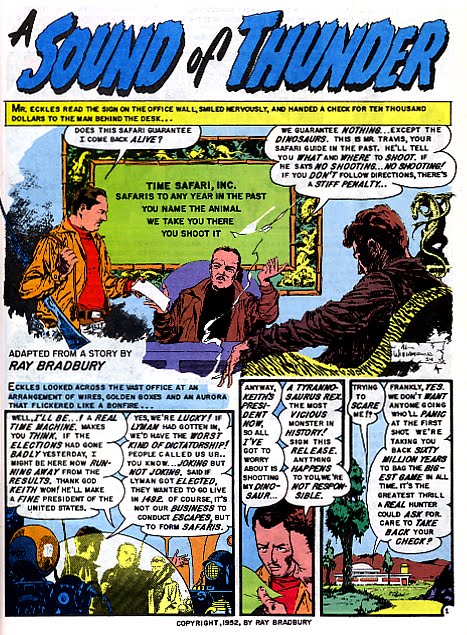
The 1990s also finally gave me a chance to read some of the work Williamson had done early in his career thanks to Gemstone Publishing’s reprinting of the EC Comics line in a new line of color comics and annuals. There I got to see at last the stuff Williamson had done early on, and it was as classically beautiful as I could have hoped. I particularly liked his adaptation of the classic Ray Bradbury short story “The Sound of Thunder,” in Weird Science-Fantasy.

I never got to meet or speak with Williamson, so I have no idea beyond others’ recollections what he was like as a person. There’s still lots of Williamson art to enjoy, with IDW adding this summer Secret Agent Corrigan to its Library of American Comics series of reprints.

Looking through samples of his work today, I can’t help but be struck by the detail and care that he obviously put into creating both fantastic worlds and also believable characters. I wish more of today’s comics artists could capture even a fraction of Williamson’s ability to make his characters look like they’re real flesh-and-blood humans, or convey a character’s attitude so clearly with a natural pose.

I’m sorry to hear he’s gone. But I know that even if I should someday stop reading comics completely, I will always never forget the beauty of his artwork and the impact it had on me as a both a young comics reader and as an adult admirer of art.

I’ll finish with a small sampling of Al Williamson images I pulled from my collection and scanned today. If you’ve never seen it, I envy you and encourage you to seek out his work. It’s worth it.

 Splash page for “Upheaval” from Weird Science-Fantasy #24 (EC Comics, 1954), as reprinted in Weird Science-Fantasy #2, (Gemstone Publishing, Feb. 1993)


 Splash page to Bradbury’s “Sound of Thunder,” from Weird Science-Fantasy #25 (EC Comics, Sept. 1954), reprinted in Weird Science-Fantasy #3 (Gemstone Publishing, May 1993)


Splash page for “Food for Thought,” from Incredible Science Fiction #32 (EC Comics, Dec. 1955) reprinted in Incredible Science-Fiction #10 (Gemstone Publishing, Feb. 1995) 


A 1970 strip from Secret Agent Corrigan taken from Library of American Comics #1, IDW’s Free Comic Book Day release in 2010.


 Interior Empire page showing a bit more of this scene than the final movie did, also from Marvel Super Special #16 (Marvel, 1980).


Interior page from Star Wars #50 (Marvel, Aug. 1981).


Page from the adaptation of Blade Runner appearing in Marvel Super Special #22 (Marvel, Sept. 1982).


 Key scene from Return of the Jedi, as seen in Marvel Super Special #27 (Marvel, 1983).


Splash page from Classic Star Wars: The Vandelhelm Mission (Dark Horse, March 1995). This one-shot featured a re-colored reprint of Star Wars #98 (Marvel, Aug. 1985).


 Page from Flash Gordon #2 (Marvel, July 1995).

Tuesday, June 8, 2010

Off the shelf: Wilson, Other Lives and Blazing Combat


Wilson (Drawn & Quarterly, $21.95, 80 pages) is the most-recent release from Daniel Clowes of Ghost World fame, telling the life story of a guy who is most accurately described as a misanthropic jerk in a series of one-page stories. At first, the format is a bit choppy and repetitive, but these little vignettes — each playing out like a little remembered incident you might tell at a party — start to add up and have a surprisingly emotional effect. Wilson’s story is a sad one and he’s not the first character of this type that Clowes has tackled, but the relentlessness with which Wilson is shown to constantly choose to be a jerk is compelling as it goes from annoying to self-destructive to sadly sympathetic. It’s not the easiest thing to get into, but it’s well worth it.

I’ve long been a fan of Peter Bagge’s talent for creating completely believable and weird characters, and his most-recent outing — the Vertigo original graphic novel Other Lives (DC/Vertigo, $24.99, 136 pages) — is no exceptions. Here, Bagge delves into a world where everyone is pretending at least part of the time to be something they’re not. What I like the most about Bagge’s characters is the realism that results from having them think they’re a lot smarter than they are. They never see past their own fantasies to the obvious real-life conclusion that’s bearing down on them, which makes the way Bagge resolves his plots all the more fun and weird. My biggest complaint with this book is that this is a $25 hardcover graphic novel from one of the industry’s giants and it’s in black and white. This isn’t new — Vertigo’s been doing this since the likes of The Quitter, The Alcoholic and Incognegro. Honestly, I’m already paying $25 — I would pay an extra $5 if that’s what it took to get this in color.

Saving the best for last, there’s Blazing Combat (Fantagraphics, $19.99, 208 pages), an amazing collection of the stories from the short-lived cutting-edge mid-1960s Warren Publications series. These are all short stories in the mode of Harvey Kurtzman’s Frontline Combat, but with a 1960s edge to them. They’re all written by the outstanding Archie Goodwin, with a few assists, which for most fans would be reason enough to buy this comic all by itself. But then you throw in some of the most amazing art, all of it sharply and expertly reproduced, and you’ve got some real dynamite here. This book includes prime artwork from Joe Orlando, Gene Colan, Reed Crandall, John Severin, Alex Toth, Al McWilliams, Wally Wood and Russ Heath. And there’s fantastic bonus features, including interviews with original publisher James Warren and Goodwin on the book and the troubles it faced getting distribution after being labeled an “anti-war” book in the early days of the Vietnam War, and the original color covers by none other than the late Frank Frazetta. If all that doesn’t sell you on this as a must-buy, then you may need professional help.

Saturday, June 5, 2010

FF re-read: The Fantastic Four #4 (May 1962)

"The Coming of Sub-Mariner!"
Script by Stan Lee
Pencils by Jack Kirby
Inks by Sol Brodsky
Letters by Art Simek

A lot is happening in this issue, which improves significantly over the previous one in pretty much every respect.

Despite the cover, which is easily the best so far, the Sub-Mariner doesn’t show up until about halfway into this issue. I’d like to know if there were many fans who picked this up because they like Namor. At this point, he hadn’t been gone from comic book stands very long, having last appeared in a short revival attempt in the mid-1950s.

This issue starts off with Reed, Sue and Ben dealing with the departure of Johnny at the end of the previous issue, leading to a pretty effective page 2 recap of The Fantastic Four #3 that quickly brings readers up to date. I don’t know if Stan and Jack consciously decided to establish this kind of issue-to-issue continuity or if it just came about organically, but this kind of attention to details must have thrilled fans who took their comics seriously back in 1962.